













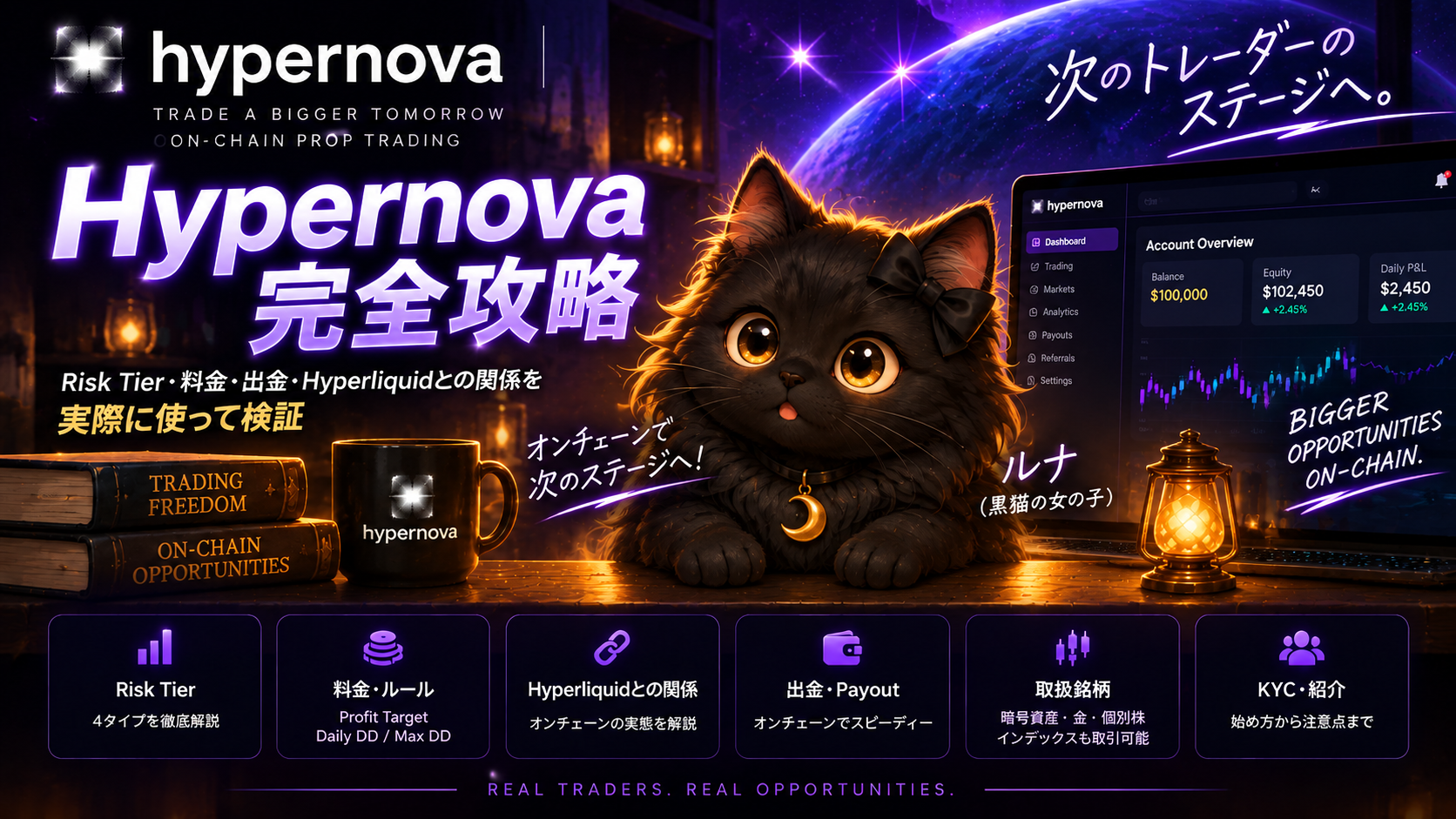

The retained Japanese hero says “Hypernova complete guide,” covering four Risk Tiers, prices and rules, the Hyperliquid relationship, payouts, crypto/gold/stock-linked/index markets and KYC. Luna introduces the next trading stage. The illustrated dashboard ($100,000 balance, $102,450 equity and $2,450 daily P&L) is decorative, not USK’s account evidence. Its speedy-payout and on-chain slogans are qualified by the observations below.
Translation date and factual scope
November 12, 2026 (JST): Checked official Rulebook v1.4 (changelog dated November 2, 2026) and Payouts. Corrected equity-based target triggers and automatic closing, funded activation, payout conditions, the 90% option, loss-limit warnings and account limits. The changelog aligns the documentation with behavior already enforced on the platform; it does not establish that these rules began on November 2. Historical screen evidence and experiences are retained.
The account walkthrough remains a historical September 2026 record. Rules below explicitly updated to v1.4 are current-document summaries; other observations are dated, not new personal tests. Rulebook / Payouts.
Sources for this article
This article combines Hypernova’s official website and documentation with screens USK checked after actually creating an account. Numbers and rules are distinguished as Official information, USK observation, Third-party information or Needs confirmation, according to their evidence.
Source update history
November 12, 2026 (JST): The English edition uses privacy-redacted copies of the Deposit and Profile screenshots. Wallet/QR and profile identities are hidden; historical figures and observations are retained.
November 12, 2026 (JST): Checked official Rulebook v1.4 (changelog dated November 2, 2026) and Payouts. Corrected equity-based target triggers and automatic closing, funded activation, payout conditions, the 90% option, loss-limit warnings and account limits. The changelog aligns the documentation with behavior already enforced on the platform; it does not establish that these rules began on November 2. Historical screen evidence and experiences are retained.
September 30, 2026: The source rechecked the official Trading Fees asset-class rates and corrected stock/ETF Taker fees to 0.03%, separate from the 0.005% rate for indices, FX and commodities including Gold.
September 11, 2026: Section 11 was corrected from “measured from actual orders” to “reference rates calculated from the pre-order Fee display.” Actual post-execution charges were not verified. Section 12’s “measured 5.9 seconds” was corrected to “the Payout dashboard displayed an average payment time of 5.9 seconds.” USK did not time it with a stopwatch. The fee figures themselves did not change.
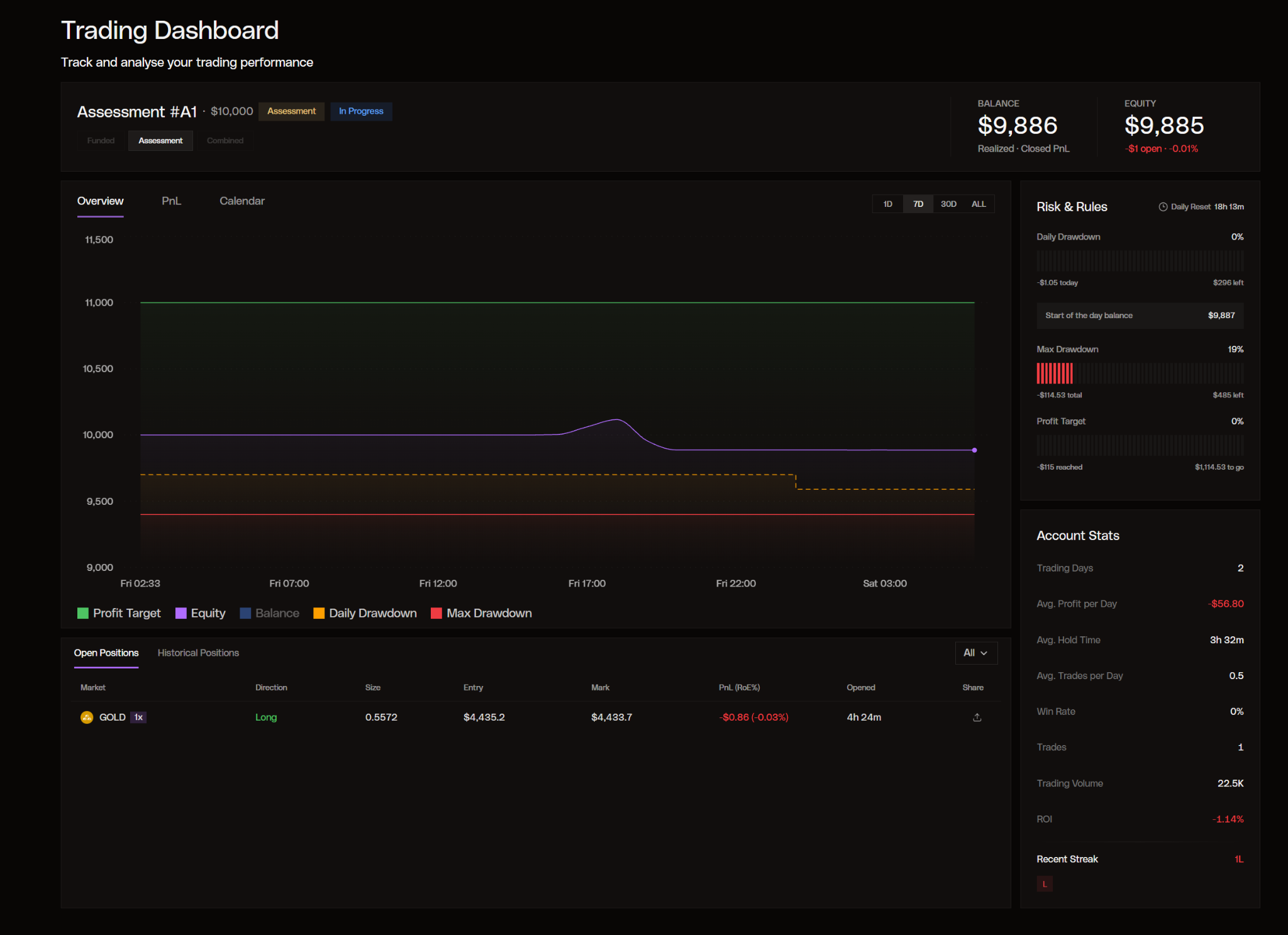
USK’s actual dashboard: Assessment #A1 ($10,000), balance $9,886 and equity $9,885, with remaining Daily Drawdown, Max Drawdown and Profit Target allowances in Risk & Rules.
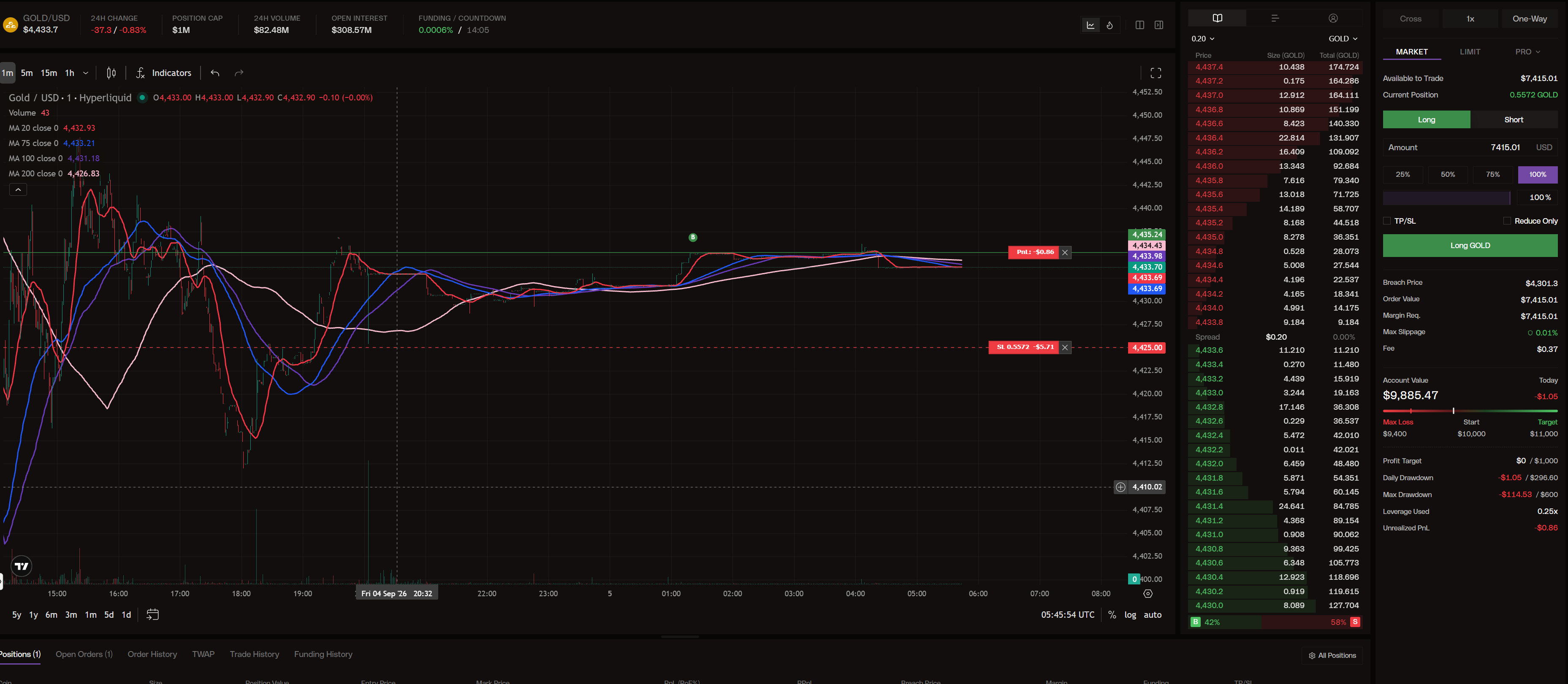
The actual GOLD/USD terminal. “Hyperliquid” above the chart identifies the price-data reference. Risk & Rules on the right shows daily drawdown, maximum drawdown and profit target in real time. It does not establish direct order routing.
1. Introduction
Toreko: Senpai, Hypernova is a brand I haven’t heard of.
USK: Official information at the time: it was a relatively new prop firm. Like Propr, which I introduced previously, it used Hyperliquid as its base, but with its own execution engine and quite a different setup. I’ll explain what I checked after actually creating an account.
Toreko: How is it different from Propr?
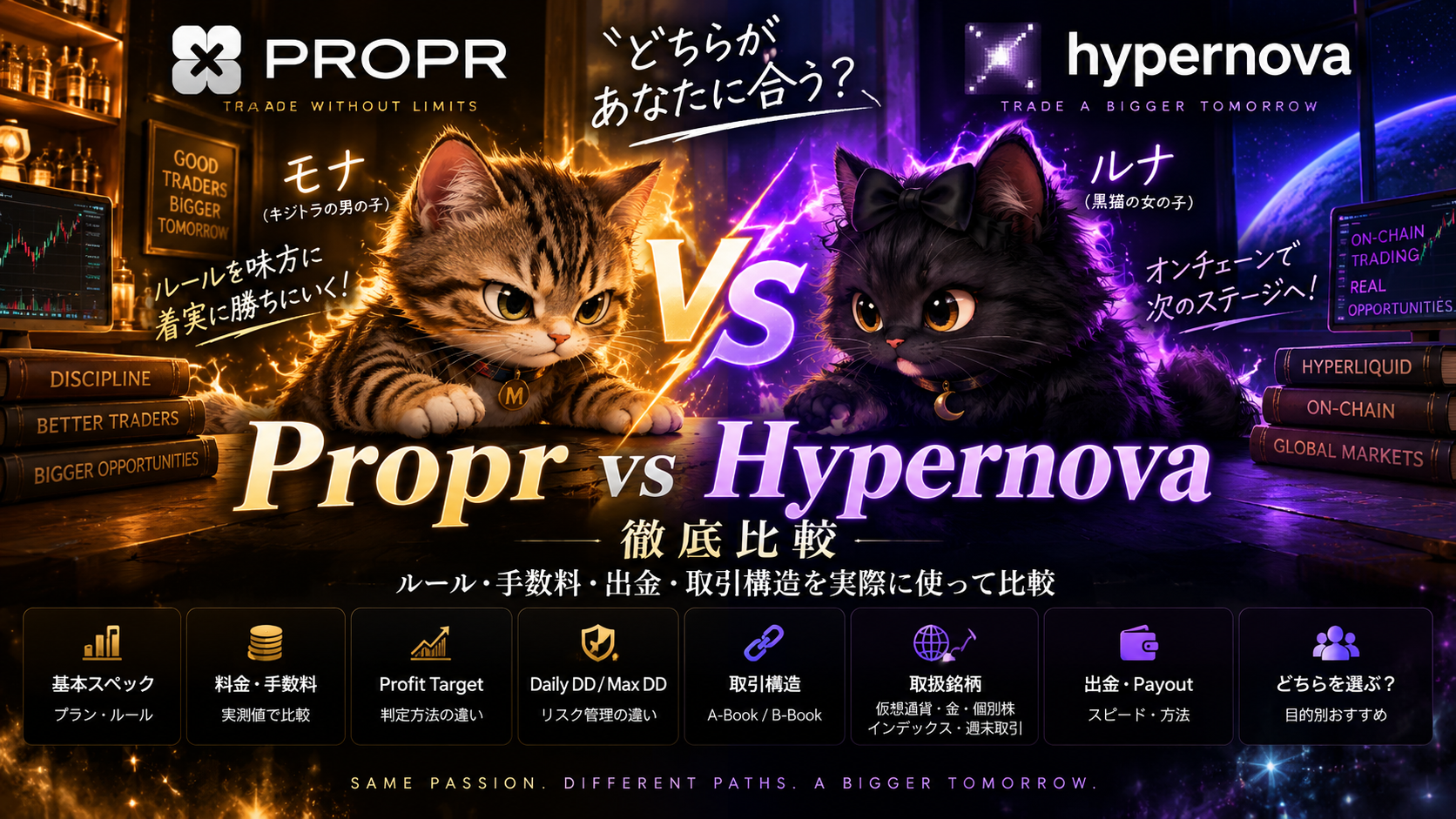
USK: The biggest differences are the Risk Tier concept and the Maker/limit versus Taker/market fee structure. Let’s go through them. Reading the Propr guide alongside this should make the differences clearer. There is also a two-firm comparison if you are interested.
Compare Propr and Hypernova and read the Propr guide (Japanese).
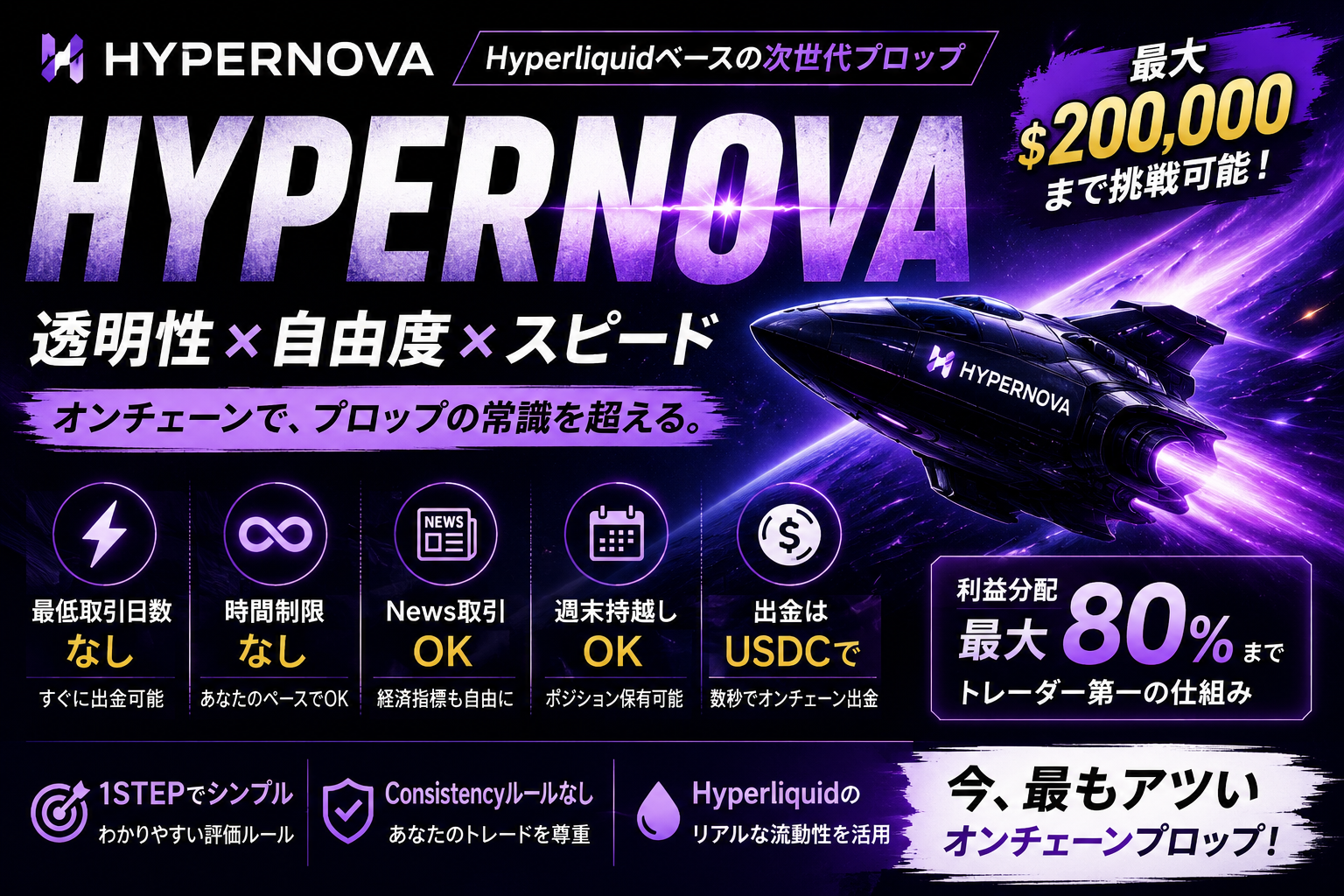
Japanese editorial banner: “transparency, freedom and speed,” up to $200,000, up-to-80% profit share and a simple 1-Step design; no minimum days, time limit or consistency rule; news trading, weekend holding and USDC payouts. Its “withdraw immediately/in seconds” wording is not a measured payout result or guarantee. “Use Hyperliquid liquidity” must not imply direct routing. The 80% maximum is historical, not the current ceiling given the later 90% add-on. The unchanged banner is historical artwork; use the current rules and payout conditions in the text.
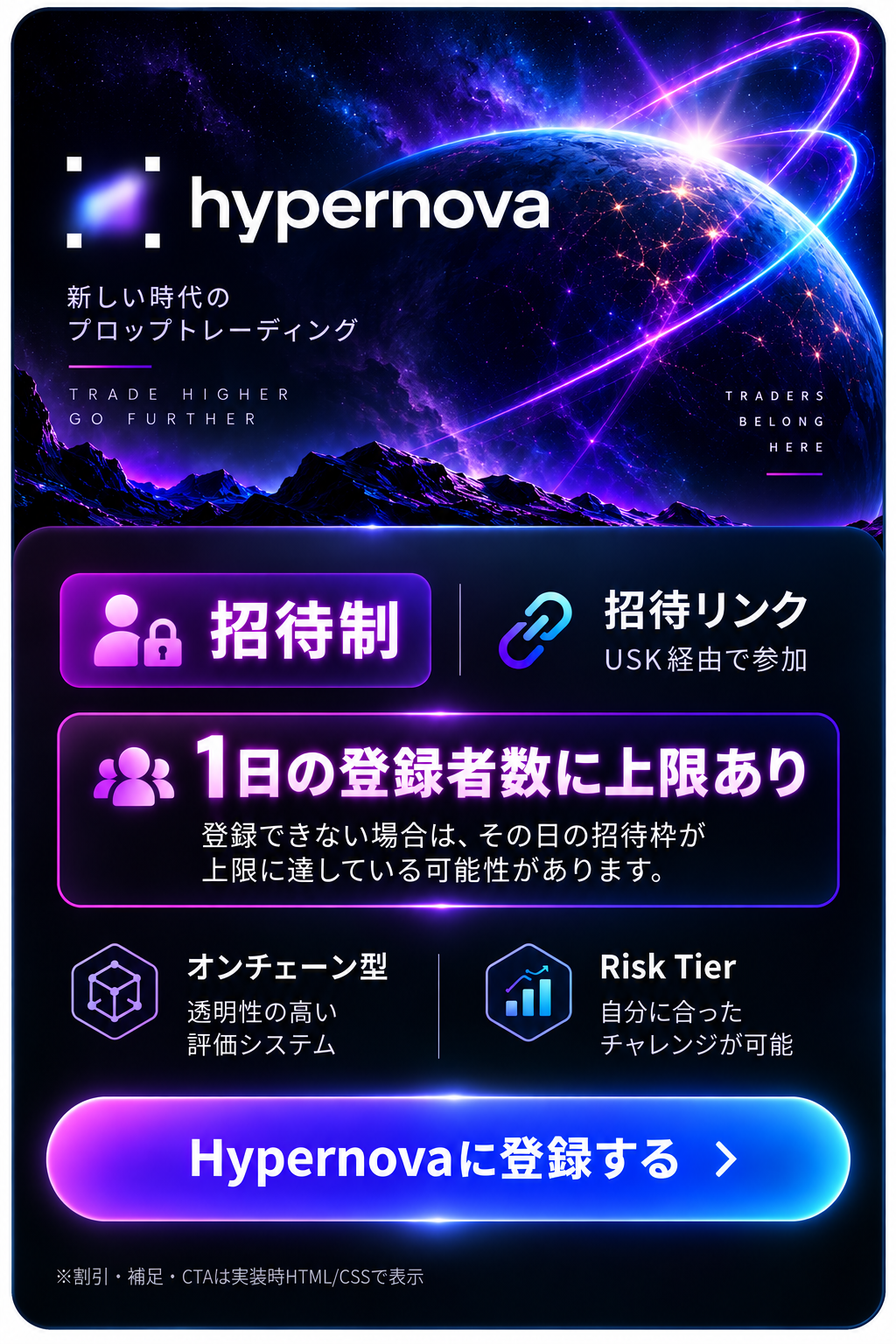
Historical invitation limit
The source reported a daily invitation cap. If registration was unavailable, the day’s quota might have been reached; trying later was suggested. Current access and remaining slots have not been verified.
PR: Visit Hypernova through USK’s referral link. This is an affiliate invitation link. Registration may be unavailable when the invitation quota is full; access is not guaranteed.
2. What is Hypernova?
USK: Official information at the source date: Hypernova called itself a “crypto-native prop trading firm,” and its site described it as being in closed beta. Joining was primarily through an invitation or waitlist.
Toreko: So it was a closed beta?
USK: Yes. Keep in mind that the information in this walkthrough could change at a formal launch.
3. The relationship with Hyperliquid
USK: Official information: Hypernova described its own execution engine built around Hyperliquid. The source contrasted this with Propr’s case-by-case A-Book/B-Book routing discretion. Hypernova processes execution through its own engine.
Toreko: What exactly does that execution engine do internally?
USK: Needs confirmation: the public site did not provide a detailed architecture diagram. Its explanation was that its own engine handled optimal execution. I could not verify the internal processing in detail.
Luna’s tip: An execution engine is the system that decides how orders are handled. Hyperliquid as the market-data source and Hypernova’s own order-processing engine are different things.
4. Its place among on-chain prop firms
USK: Official information in the source: evaluation accounts principally use simulated trading. Evaluation-fee payments and payouts both use USDC on Arbitrum. That aspect was shared with Propr.
Toreko: Are the networks different when buying an account and when withdrawing?
USK: USK observation: this is easy to misunderstand. Account-purchase deposits and payouts after trading a funded account both used USDC on Arbitrum. It wasn’t only payouts; the setup used USDC on that network from the purchase onward.
5. The Risk Tier concept
USK: Official information: Risk Tier is a distinctive feature. Tight, Low and Medium offer defined drawdown and fee choices. High is Edition-only: target 10%, daily loss 5%, static maximum loss 8%. Sizes, fees, stock and end dates depend on each release.
Toreko: Is that similar to Propr’s Classic, Turbo and Pro?
USK: There are similarities, but Hypernova’s single tier axis for choosing the strictness of DD is straightforward. Let’s look more closely next.
Luna’s tip: Risk Tier means choosing how much drawdown, or loss allowance, you want to trade within. Wider tiers generally give more room but tend to cost more in evaluation fees.
6. Tight, Low, Medium and High
USK: Official information: Tight, Low and Medium below follow Rulebook v1.4. High is Edition-only, not generally available.
| Risk Tier | Profit Target | Daily Loss | Max DD |
|---|---|---|---|
| Tight | 9% | 3% | 3% |
| Low | 10% | 3% | 6% |
| Medium | 10% | 4% | 7% |
| High (Edition-only) | 10% | 5% | 8% |
Toreko: The profit target changes with the tier too?
USK: Official information: only Tight has a slightly lower target of 9%; Low, Medium and High use 10%. High is Edition-only. The DD allowance increases gradually by tier.
7. Prices
USK: Official information at the time: account sizes ranged from $5,000 to $200,000. Price depended on both Risk Tier and account size.
Toreko: Do you have screenshots of the plan-selection screen?
USK: USK observation: yes. For $50,000, the translated labels were “Precision,” assumed Tight, at $200; “Conservative,” assumed Low, at $500; and “Standard,” assumed Medium, at $675. “Aggressive,” assumed High, was locked and marked coming soon.
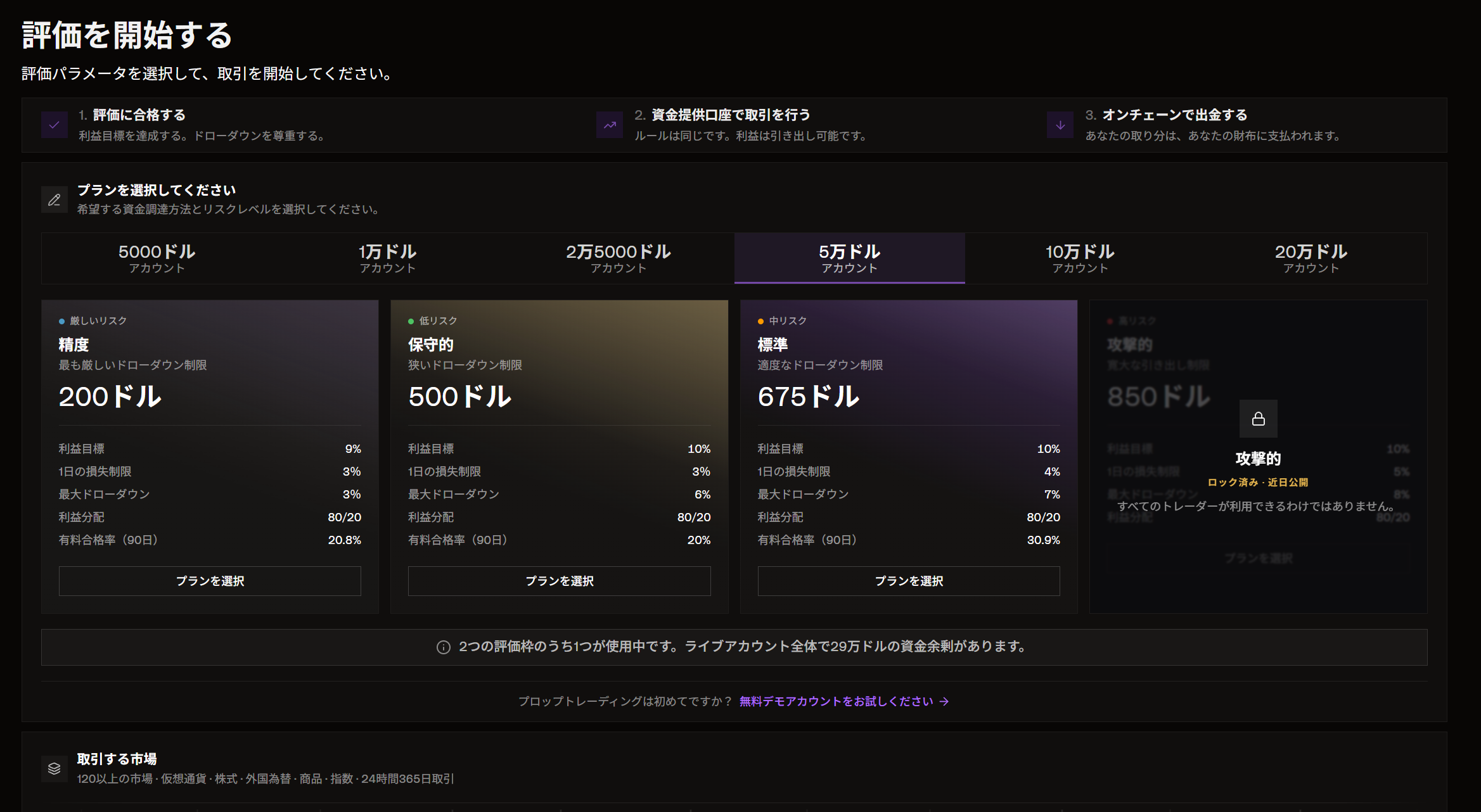
Historical $50,000 selection: Precision $200, target 9%, max DD 3%; Conservative $500, target 10%, max DD 6%; Standard $675, target 10%, max DD 7%. Aggressive was locked, “coming soon.” This is not current price or availability evidence. Other marketing statistics visible here were not independently measured.
USK: USK observation: I also checked $200,000. Precision was $800 and Conservative $1,950. Standard said “unavailable, maximum $100,000,” so it could not be selected at $200,000. Aggressive was locked.
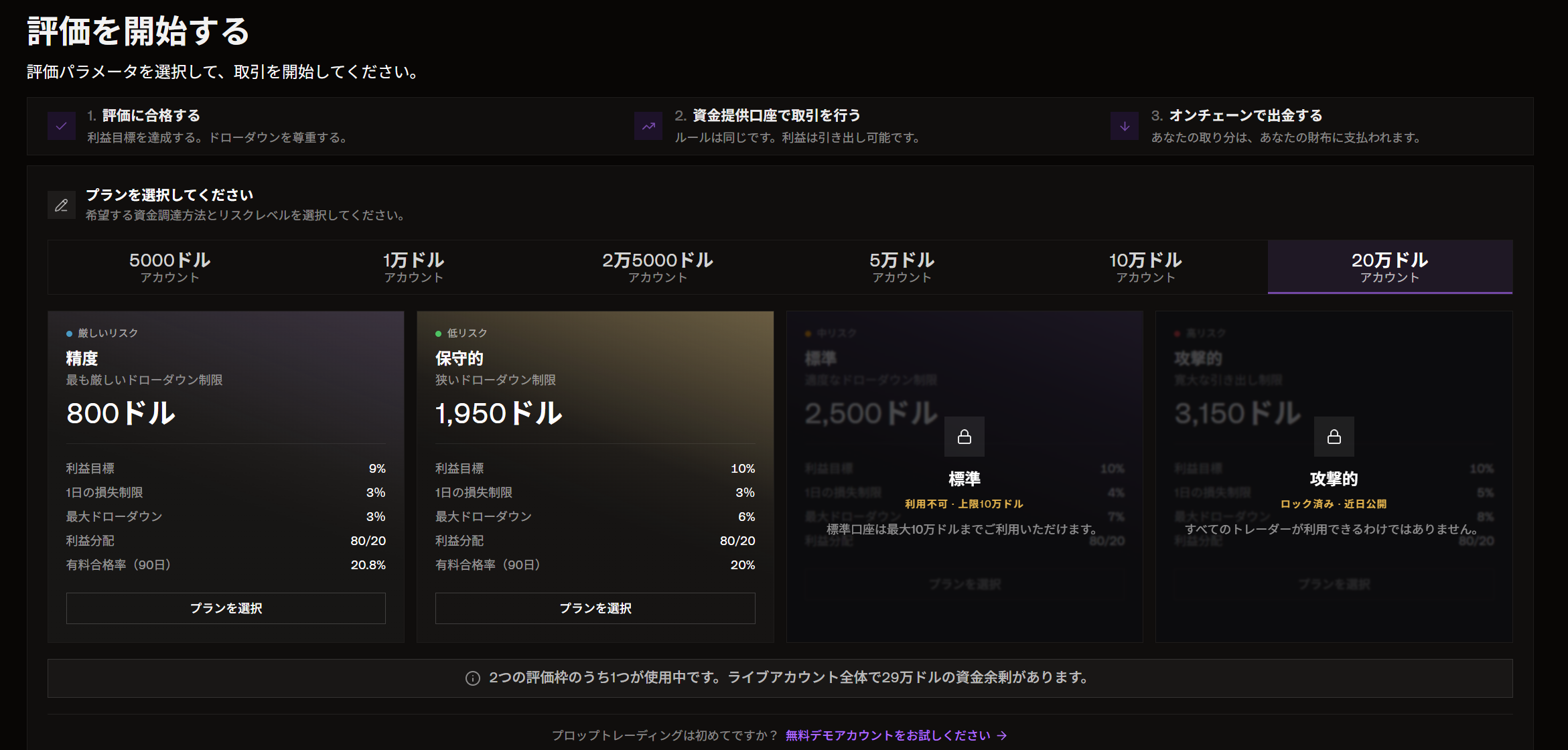
Historical $200,000 screen: Precision $800, target 9%, max DD 3%; Conservative $1,950, target 10%, max DD 6%. Standard was limited to $100,000 and unavailable here; Aggressive was locked. Current v1.4 lists Medium $200K at $2,700; the old screen is retained as historical evidence, not a current restriction.
Invitation availability
The source warned that daily invitation capacity could prevent registration. Neither current capacity nor live checkout prices have been verified.
PR: Check current official prices through USK’s referral link. An exhausted invitation quota may prevent registration.
Current Rulebook Low fees: 5K $60 / 10K $115 / 25K $280 / 50K $495 / 100K $999 / 200K $1,950. These are document values, not a fresh checkout test. Verify the purchase screen and applicable terms. High sizes, fees, stock and end dates depend on each Edition; its target/daily/max-loss parameters are 10%/5%/8%.
8. Daily Drawdown and Max Drawdown
Daily Loss (Daily Drawdown)
USK: Official information: Daily Loss is 3% for Tight/Low, 4% for Medium and 5% for High. The calculation reference is the prior day’s closing balance, including realized but excluding floating P&L. It is recalculated each day at 00:00 UTC.
Rulebook §04 also describes a notification while a position is open when equity has used 90% of either the daily or maximum loss allowance. The notification channel is not specified. A warning is not a guaranteed buffer: equity touching the Daily or Max Loss floor causes a breach. Do not wait for a warning before managing risk.
Max Drawdown
USK: Official information: Max DD is 3% for Tight, 6% for Low, 7% for Medium and 8% for High. It is static, based on the starting balance when the account opens.
USK: Balance and equity are different tests
The limit is calculated from balance, but whether it has been touched is monitored in real time using equity, including floating P&L. The calculation reference differs from the value used to test for a breach. An open loss can touch the floor and cause a breach before a position is closed. This applies to Daily Loss and Max DD alike.
Actual Risk & Rules display: Daily Drawdown −$1.05 that day, $296 left; start-of-day balance $9,887; Max Drawdown −$114.53 total, $485 left; Profit Target −$115, with $1,114.53 to go. These are historical rounded screen values.
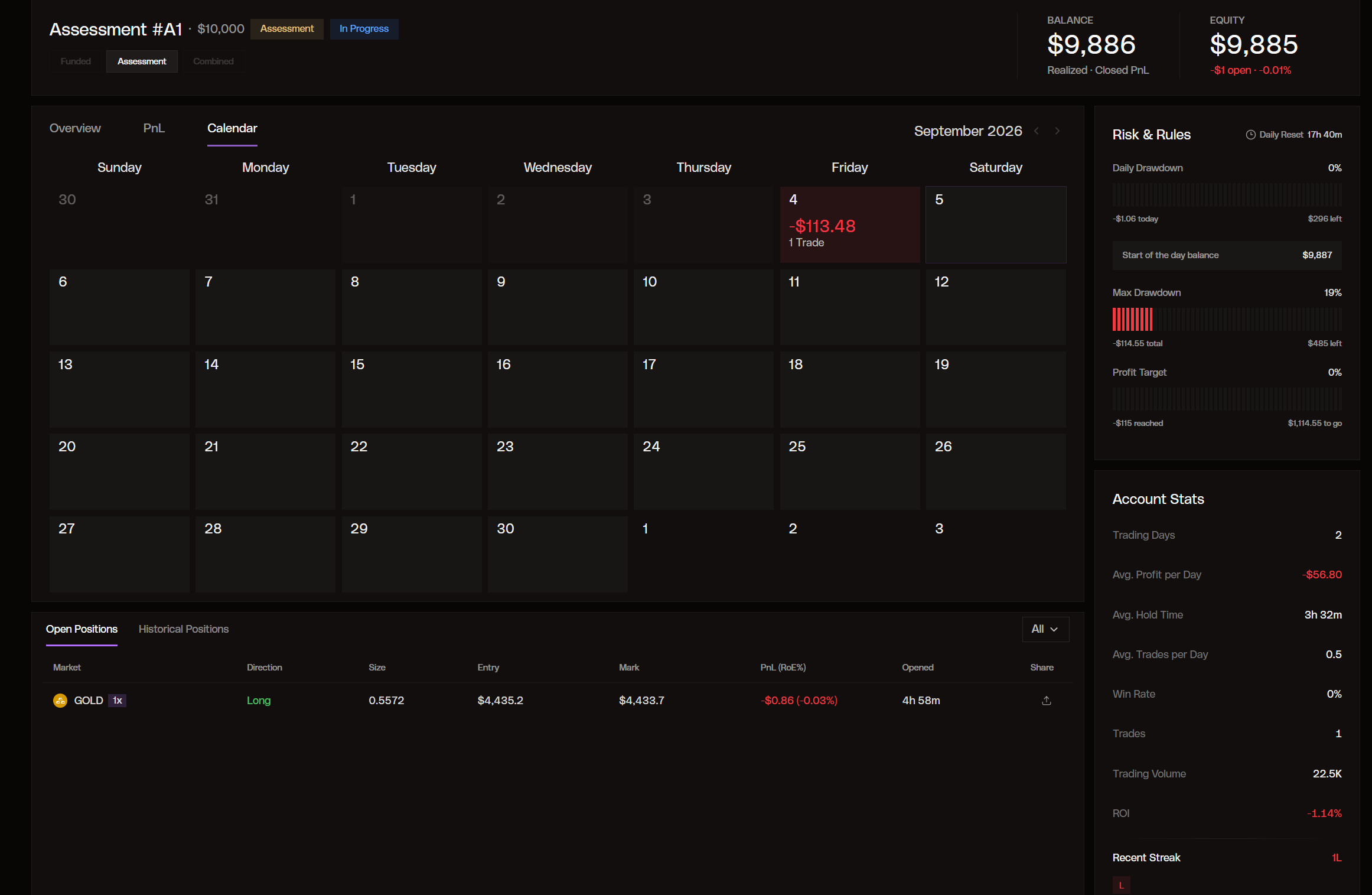
The Calendar tab displays daily P&L, balance $9,886, equity $9,885, Risk & Rules and account statistics such as trading days and win rate together.
9. The Profit Target uses equity
USK: Equity triggers the target
Hypernova evaluates the Profit Target using equity, including unrealized P&L. Even a brief touch of the target triggers automatic closing of open positions, cancellation of open orders and an automatic assessment pass.
Source: Rulebook §08, v1.4, checked November 12, 2026 JST. The old balance-based description is corrected. Using balance to calculate the Daily DD allowance is distinct from monitoring equity for target and loss-limit triggers.
Toreko: Does the system close positions even when the target is reached through floating profit?
USK: That is what the official rule states. It is not waiting for you to realize the profit yourself. Manage the position without assuming you can keep it open beyond that threshold.
The v1.4 changelog describes documentation corrections to behavior already enforced on the platform. November 2 is the changelog date, not proof of a new implementation date. Historical USK evidence remains unchanged.
10. Markets and asset classes
USK: Official information: the site categorized markets as Crypto, TradFi, meaning traditional financial assets, and Pre-IPO. TradFi included commodities such as gold and stock indices.
USK: Needs confirmation, with conflicting information: the consulted materials gave both “99” and “140” markets. I could not establish which was correct at the source date. The current Markets page lists 106 perpetuals as checked November 12, 2026 JST; the screens below remain historical.
Toreko: Could you count them in the actual dashboard?
USK: USK observation: I can show part of the Stocks tab I checked, but I did not count every market, so I cannot state a total.
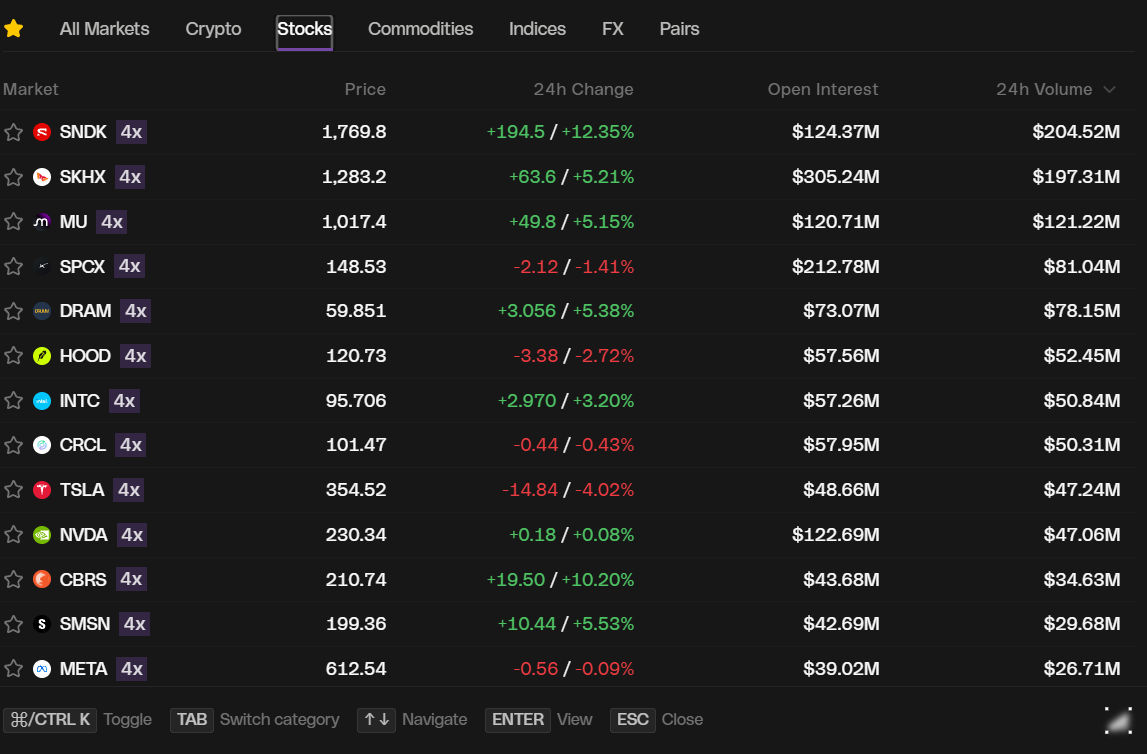
Stocks tab: SNDK, SKHX, MU, SPCX, DRAM, HOOD, INTC, CRCL, TSLA, NVDA, CBRS, SMSN and META, all displaying 4x leverage. These are platform ticker labels, not ownership of the underlying shares.
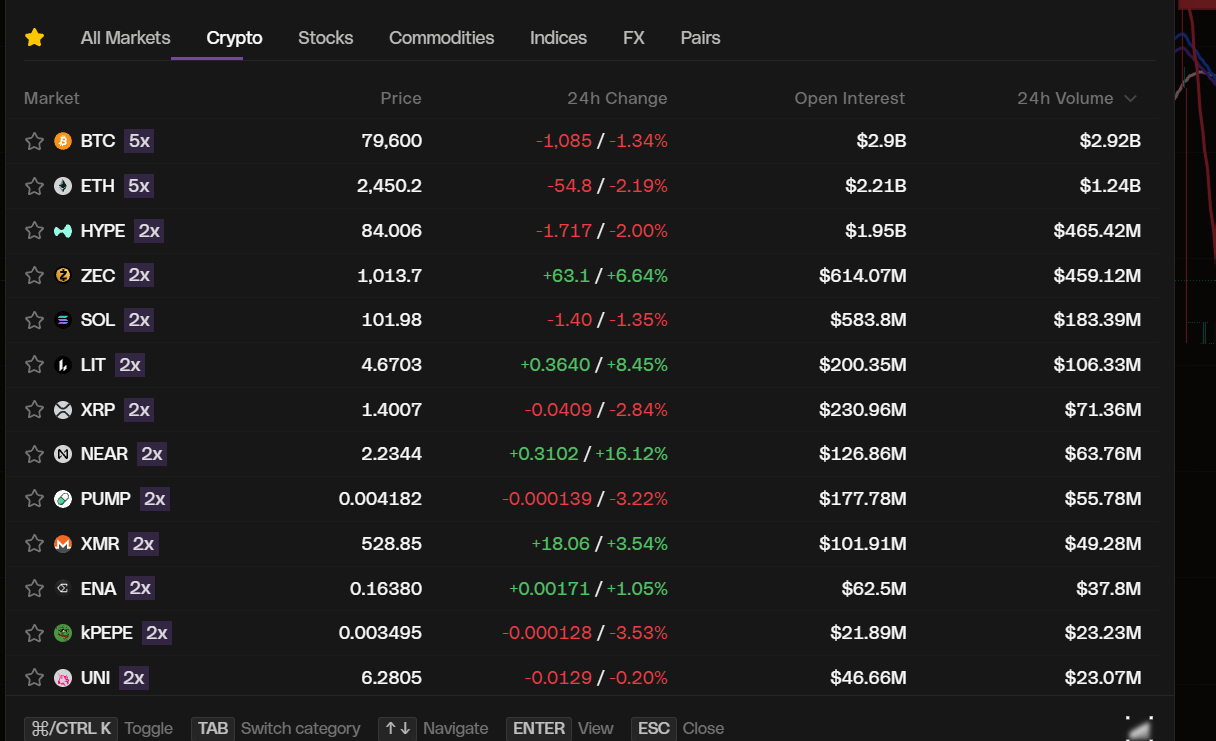
Crypto tab: BTC and ETH at 5x; HYPE, ZEC and SOL at 2x; XRP, NEAR, PUMP, XMR, ENA, kPEPE and UNI among the listed altcoins.
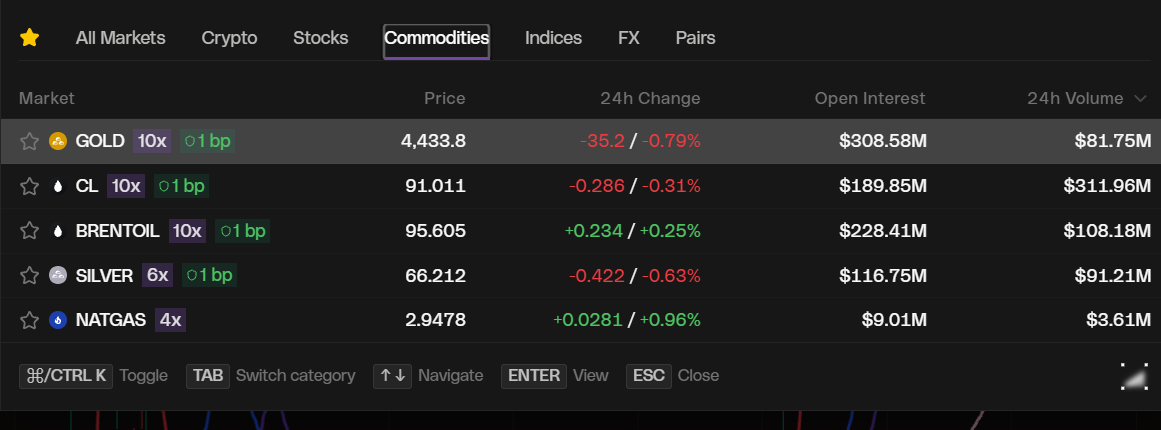
Commodities tab: GOLD 10x, CL (crude oil) 10x, BRENTOIL 10x, SILVER 6x and NATGAS 4x.
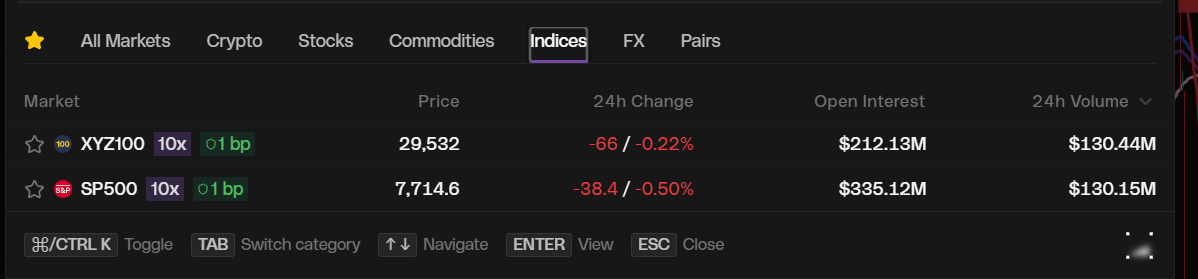
Indices tab: XYZ100, described in the source as Nasdaq-like, at 10x; SP500 at 10x.
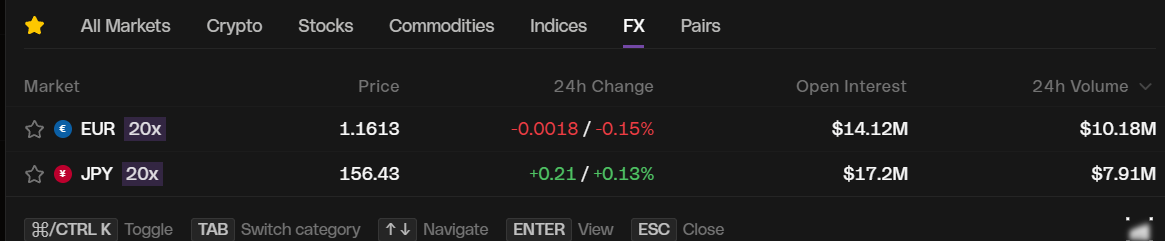
FX tab: EUR and JPY, both at 20x.
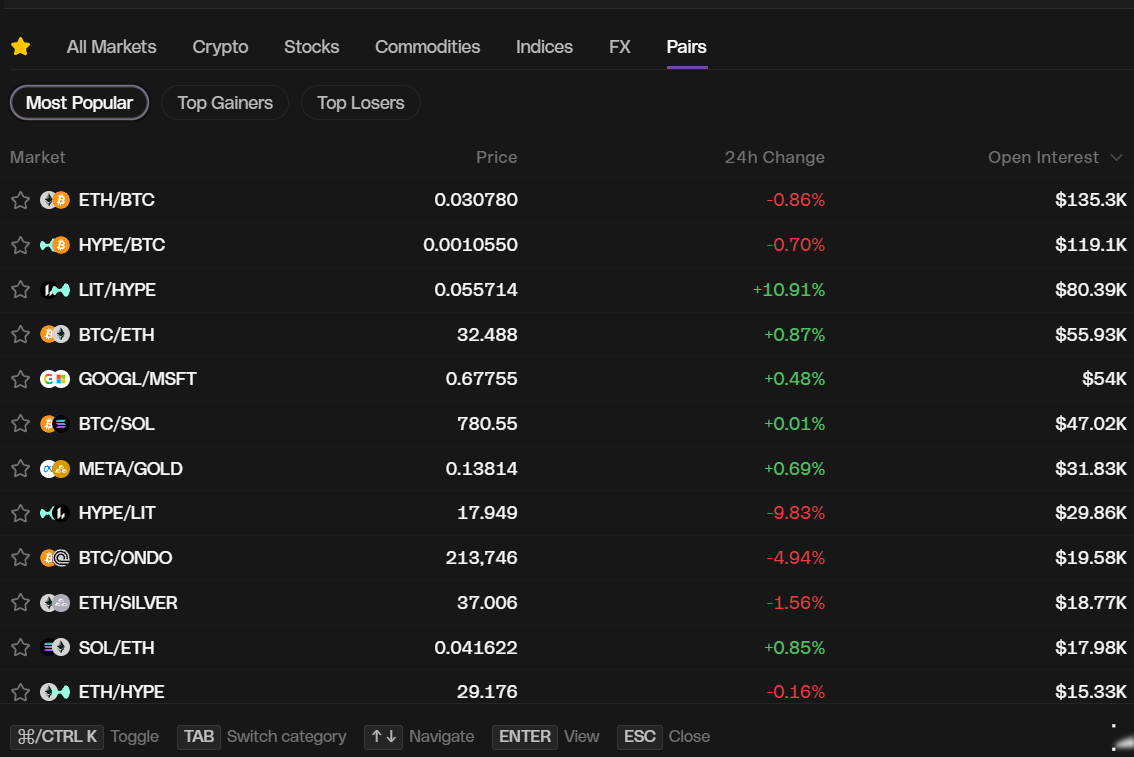
Pairs tab: ETH/BTC, HYPE/BTC, GOOGL/MSFT and META/GOLD illustrate pairs directly linking two instruments.
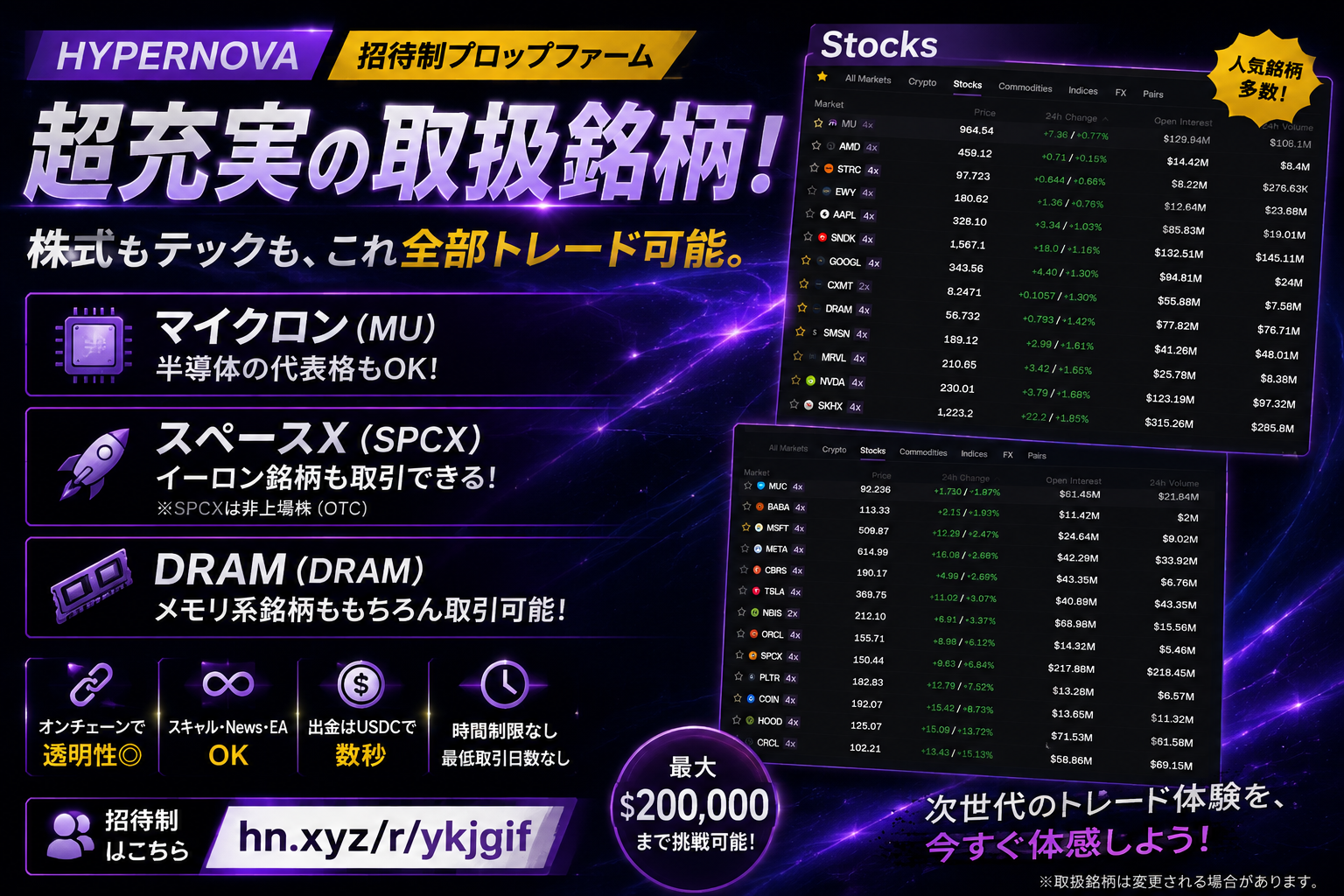
Japanese market banner: the Stocks screenshots list Micron (MU), AMD, AAPL, GOOGL, TSLA, COIN, HOOD, SpaceX-labelled SPCX and DRAM, among others. The artwork calls SPCX an unlisted/OTC stock; this is not evidence of buying actual SpaceX shares. These are the service’s derivative-market labels. It also advertises scalping/news/EA use, no time limit or minimum days, up to $200,000 and USDC payouts “in seconds.” These claims are subject to the detailed rules below; speed is not USK-measured. The Japanese artwork remains a historical illustration, not a current rule summary. Market availability may change.
Toreko: There are lots of stock names too! What happens on weekends?
USK: Weekend access is not identical liquidity
Weekend access is a notable feature. Gold, stock-linked markets and indices are offered as Hyperliquid-based perpetual contracts, so positions can be held and markets traded while traditional exchanges are closed. Weekend liquidity may be thinner, however. Treat spreads and execution conditions separately from normal weekdays; access does not mean equal liquidity.
11. Maker/Taker fees and funding
Hypernova trading fees
USK: Official information at the source date: Hypernova published Maker/limit and Taker/market rates by asset class on its Trading Fees page.
Historical rates recorded in the September 30 review:
| Market | Maker (typically limit) | Taker (typically market) |
|---|---|---|
| Crypto | 0.01% | 0.04% |
| Stocks and ETFs | 0% | 0.03% |
| Commodities, including Gold | 0% | 0.005% |
| Indices | 0% | 0.005% |
| FX | 0% | 0.005% |
Source: Hypernova Trading Fees, rechecked by the Japanese source September 30, 2026. Stock/ETF Taker 0.03% differs from commodity/index/FX Taker 0.005%. Gold is a commodity. The dedicated official Trading Fees page was directly rechecked on November 12, 2026 JST and agrees with these rates. The order-screen examples remain historical observations.
Luna’s tip: Makers place resting orders and supply liquidity; takers execute against resting orders and consume it. See the glossary below.
This article uses Maker/limit and Taker/market as shorthand. The actual classification depends on supplying or consuming liquidity. A limit order that executes immediately can be a taker.
USK: USK observation: I checked four pre-order Fee displays and calculated reference rates from the displayed fee and order value. These are not verified post-execution charges.
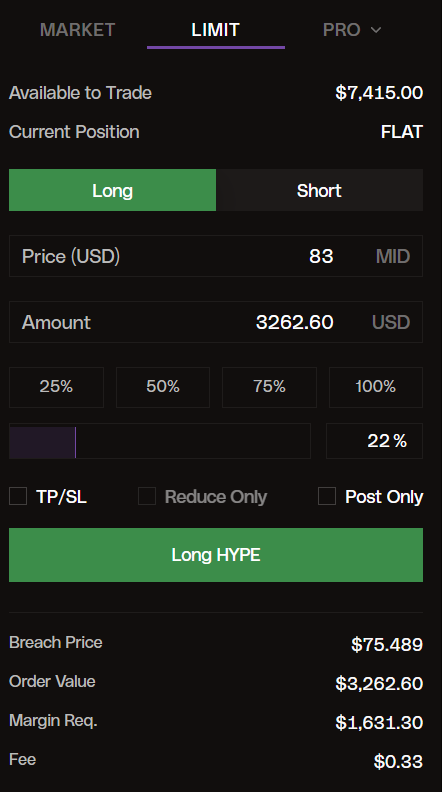
HYPE limit: Order Value $3,262.60, Fee $0.33. The displayed figures imply about 0.0101%, close to the listed 0.01% Maker rate.
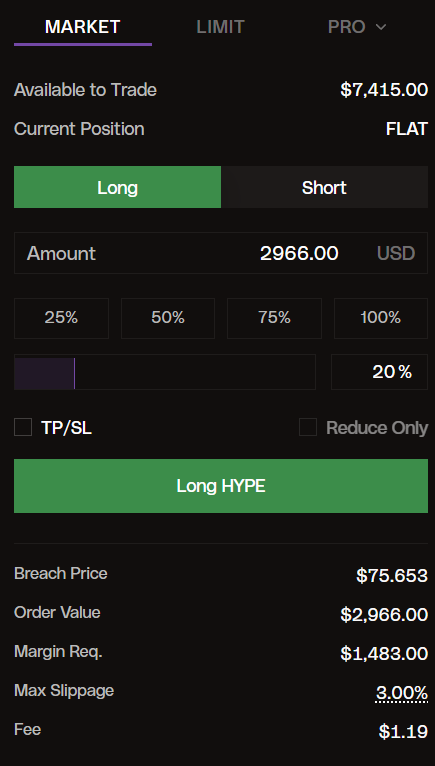
HYPE market: Order Value $2,966.00, Fee $1.19, implying about 0.0401%, close to the listed 0.04% Taker rate.
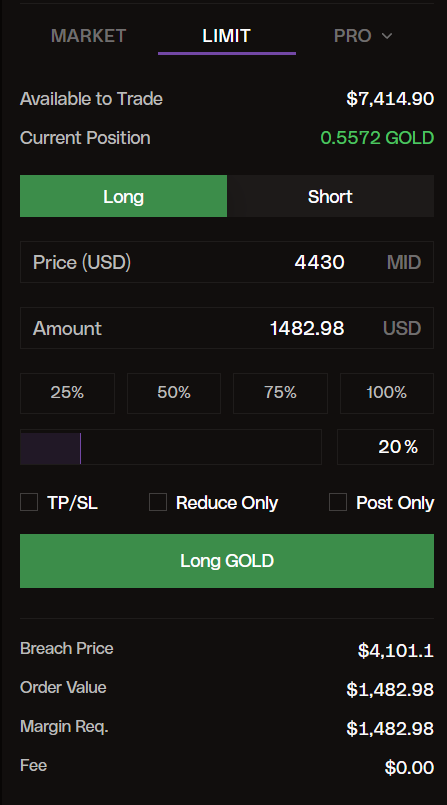
GOLD limit: Order Value $1,482.98, Fee $0.00. This is 0% using the displayed rounded figures, consistent with the listed 0% Maker rate.
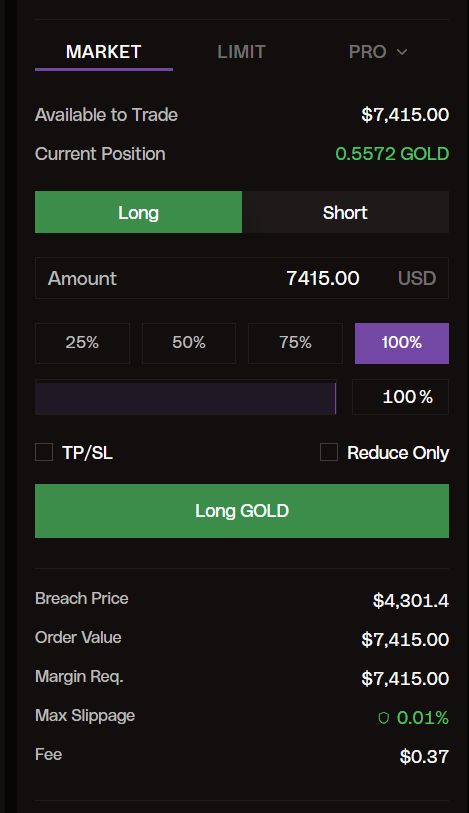
GOLD market: Order Value $7,415.00, Fee $0.37, implying about 0.00499%, close to the listed 0.005% Taker rate.
What USK checked: pre-order displays
The four HYPE and GOLD pre-order Fee displays were consistent with the source’s official rates, allowing for small rounding differences. They do not verify actual post-execution charges or every TradFi instrument. Reference calculation: displayed fee divided by displayed order value, multiplied by 100.
Funding
USK: Official information: funding references Hyperliquid’s rates and occurs hourly, on the UTC hour. It is an adjustment exchanged between long and short traders rather than a platform commission.
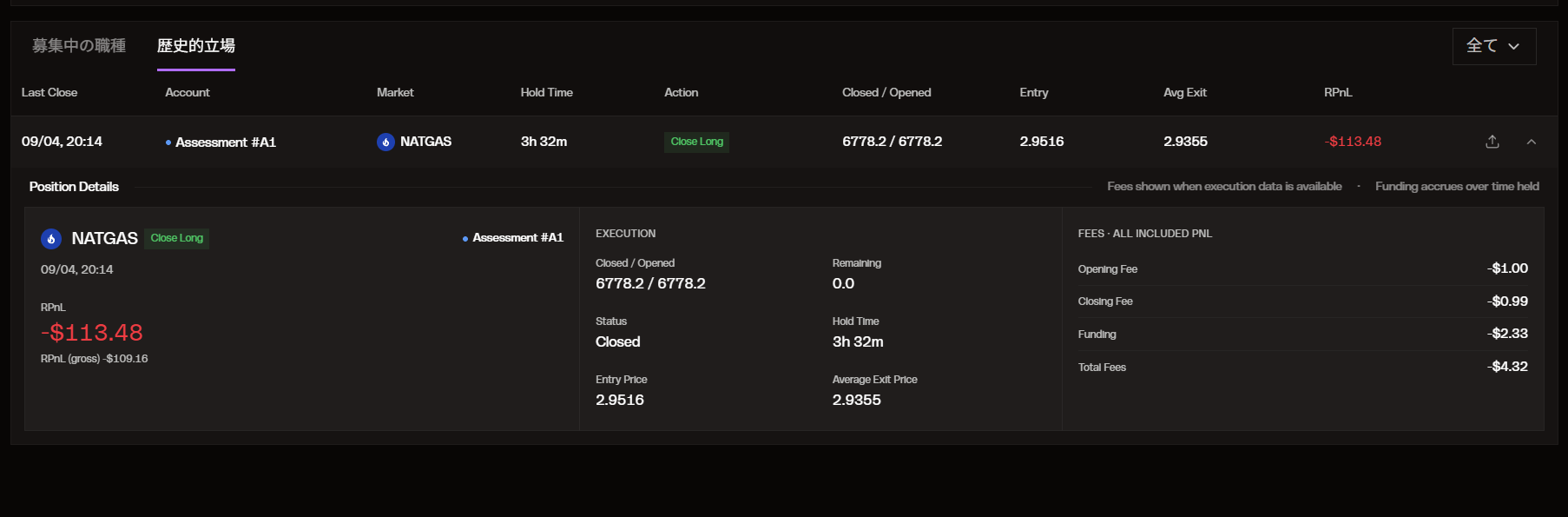
The actual trade-detail screen separates entry/exit prices, P&L, fees and funding. This particular NATGAS example shows 3h 32m holding time and −$2.33 funding, not a one-day/$1 measurement.
USK: USK observation in the original account: in one case I checked, funding was roughly $1 even after holding for a day. But it varies with the market, position size and funding rate; it is not a fixed amount. My view was that ordinary short-to-medium-term trades did not need excessive concern, while large positions held a long time deserved attention.
The one-day/$1 recollection is separate from the displayed NATGAS trade. This screenshot does not substantiate that particular estimate; do not treat it as a funding-cost promise.
12. Payouts
Current payout conditions (checked November 12, 2026 JST)
The official Rulebook §10 and Payouts specify:
- No minimum payout amount, but an active Funded account in profit and approved KYC are required. The account must be flat: no open positions, pending orders, active TWAPs or pending pair trades.
- A short payout waiting period after the first assessment purchase. The public documents do not specify a fixed number of days or hours; check the dashboard’s eligibility state rather than assuming one.
- At least one new round-trip trade (open and close) between payouts.
- During Private Beta, a $10,000 gross-profit cap per user per UTC day, combined across all Funded accounts. This is the amount before the trader’s profit split, not take-home cash.
- An 80% standard trader share. Tight, Low and Medium offer a 90% option at purchase for a 15% increase in the assessment fee. This does not automatically upgrade existing accounts. A $1,000 gross request at 80% pays $800 to the wallet.
- Identity, compliance, fraud or risk review may hold an account or payout. The published approximately five-second process is not a guarantee for every request.
A payout is not treated as a loss for Daily DD. Rulebook §05 lowers that day’s daily equity limit by the payout amount. The next day’s limit is recalculated from balance at 00:00 UTC. This is separate from the static maximum-loss floor.
USK: Official information in the source: like Propr, Hypernova used on-chain USDC payouts on Arbitrum, with a Private Beta cap of $10,000 gross profit per user per UTC day across all Funded accounts.
USK: USK observation: the actual Payout dashboard displayed an average payment time in seconds. But that was a dashboard figure, not a withdrawal I timed myself.
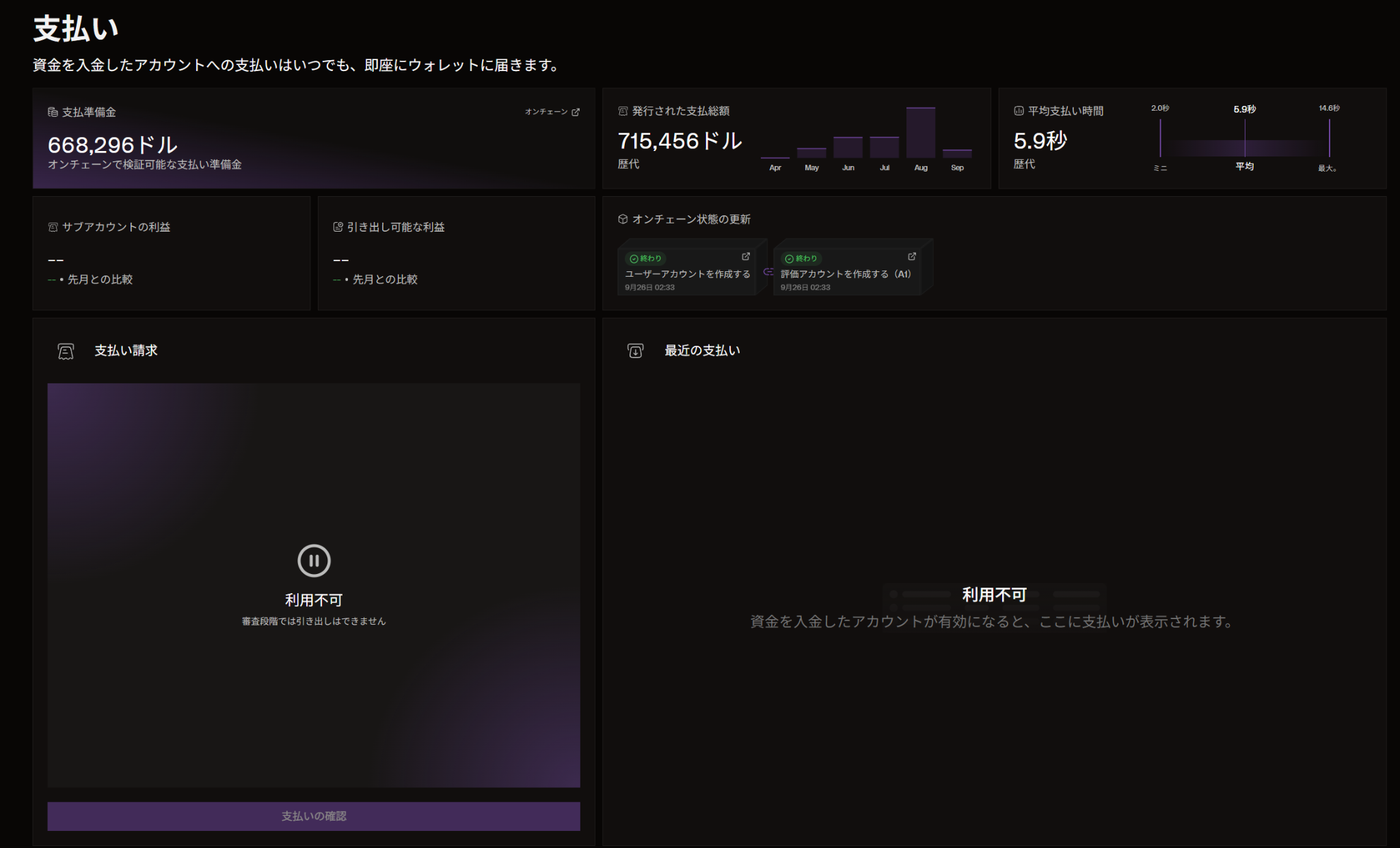
The dashboard displayed “average payment time: 5.9 seconds.” This is the platform’s own figure, not USK’s measurement from request to receipt. Payout requests were unavailable at the assessment stage shown.
USK screen observation, not a timed payout
The actual dashboard showed 5.9 seconds as its average. It was self-reported, not a stopwatch measurement. At the time of the original article, I had not yet withdrawn from Hypernova and intended to check the duration when I did. This translation does not claim a later payout occurred.
13. Deposits and withdrawals on Arbitrum
USK: Official information: deposits to buy an account and payout withdrawals both use USDC on Arbitrum. The screen explicitly says “Only send USDC on Arbitrum One,” warning against the wrong network.
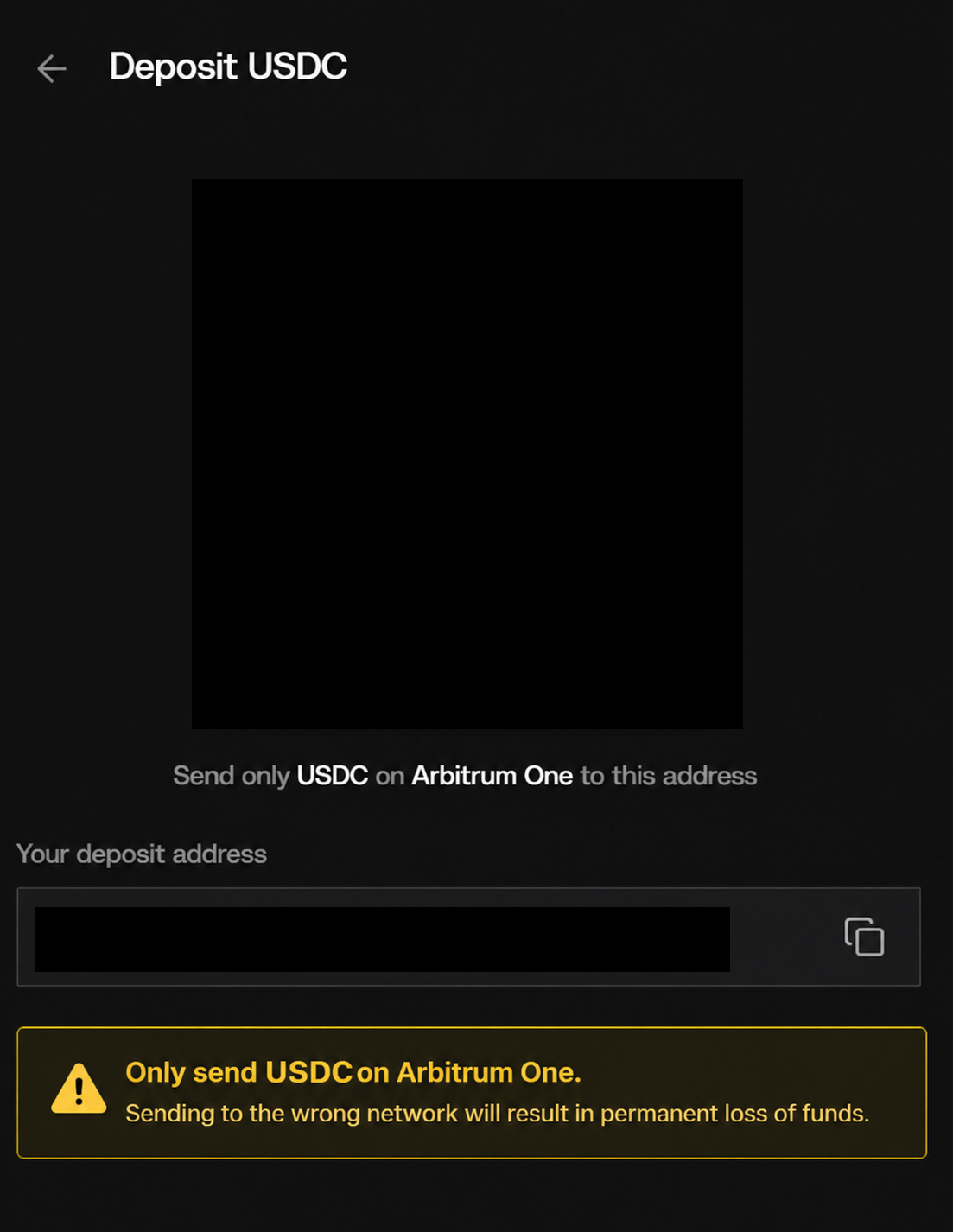
Deposit USDC screen: only USDC on Arbitrum One; the wrong network can permanently lose funds. The complete wallet address and QR code, including their edges, are blacked out in this English edition. All other screenshot pixels are unchanged. Do not send funds to an address shown in an article image.
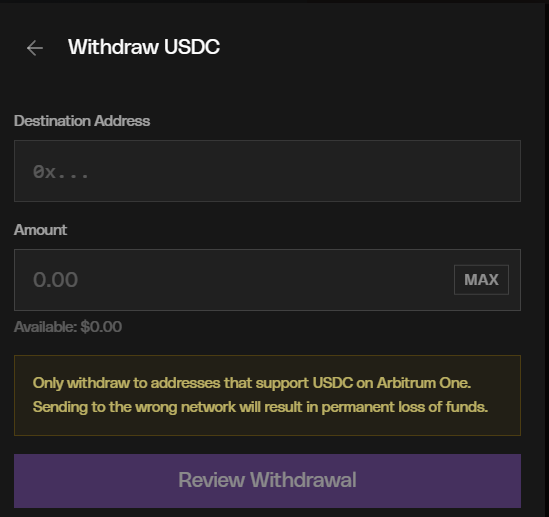
Actual Withdraw USDC screen, with no withdrawal history evidenced: blank destination, $0.00 available and a warning to use an address supporting USDC on Arbitrum One. The wrong network can cause permanent loss.
14. KYC and Funded activation
Passing the assessment does not by itself activate a Funded account. Rulebook §09 requires completed KYC and a wallet signature on the Funded Trader Agreement.
The official identity-verification FAQ says registration, deposit and assessment do not require KYC, but Funded activation does. The flow is Settings → Payouts, using government-issued photo ID and a camera selfie; the trader must be at least 18. These are official instructions, not a claim that USK completed this process in the current review.
Account limits
Under Rulebook §15, self-service Assessment and Funded accounts share a $300,000 combined starting-capital cap, including suspended Assessments and passed Funded accounts not yet activated. Demos are separate. The v1.4 correction removes the two-ongoing-assessment limit; the old one-per-asset-class explanation is not the current rule.
New Assessments include all markets. Existing Crypto/TradFi accounts retain their previous market access. Do not infer the applicable version for every old account; check its purchase/activation terms and account display.
15. Japanese-language support
USK: USK observation: in the site and app areas I checked, I did not find native Japanese display; English was the main language.
Japanese text in some retained screenshots comes from translation tools, not proof of native Japanese support. Current language availability was not independently retested.
16. Unrestricted rules and prohibited conduct
USK: USK observation: I checked the in-app “What is not restricted” page too. It used a light-mode interface, which looked different from Propr’s equivalent page.
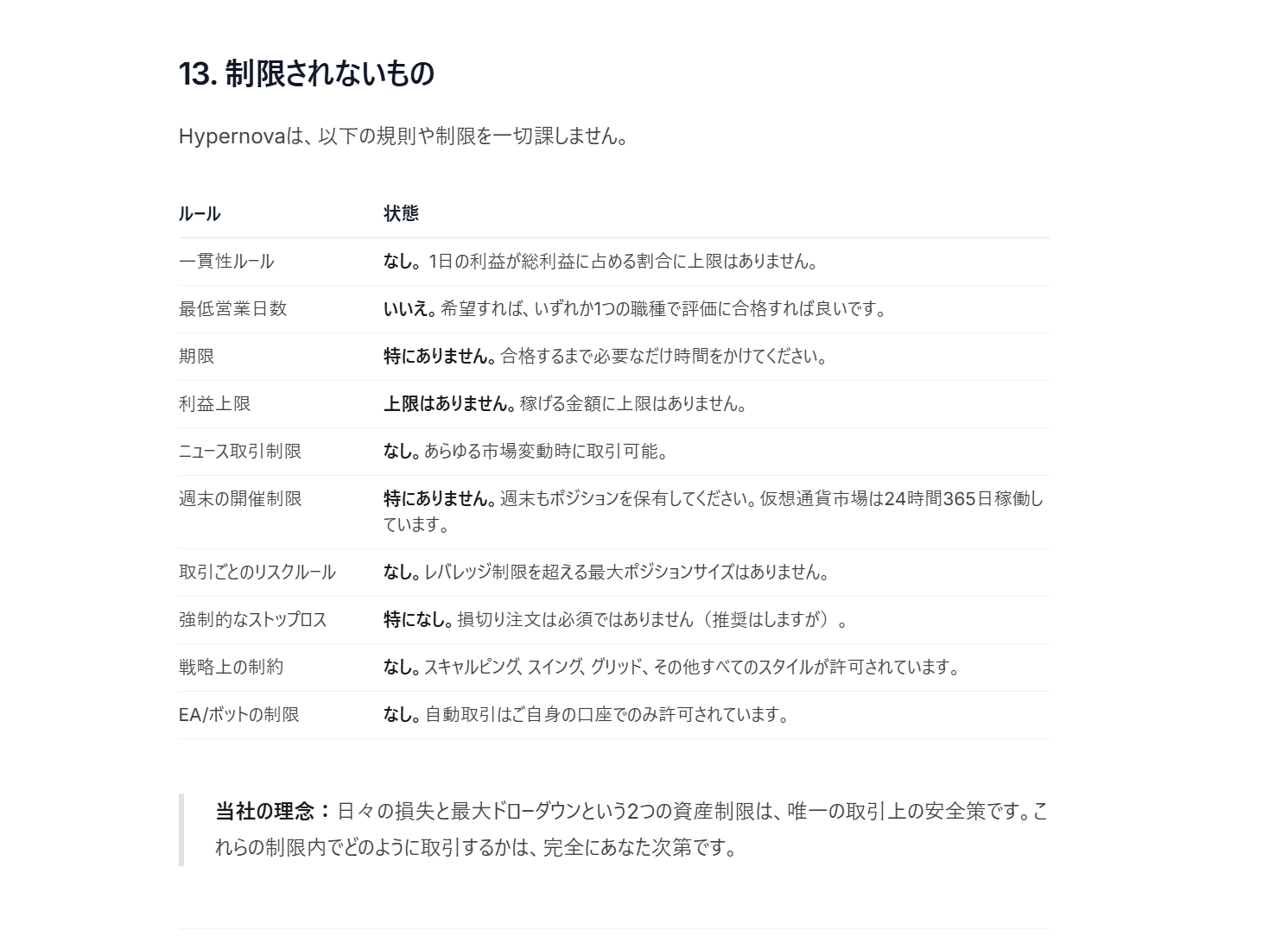
English explanation of the Japanese-translated list: no consistency rule or cap on one day’s share of total profit; no minimum trading days; no time limit; no profit cap; no news-trading restriction; weekend holding permitted, with crypto markets described as 24/7; no separate per-trade risk rule beyond leverage limits; stop losses optional but recommended; scalping, swing, grid and other styles permitted subject to prohibited conduct; EAs/bots only on your own account. The source screenshot’s “one occupation” wording is a translation artifact in its minimum-days row, not a new eligibility category. The general freedom language does not override the prohibitions below.
Toreko: What is prohibited, then?
USK: USK observation: I checked the prohibited-conduct page too. Alongside items shared with Propr, such as account sharing, impersonation and exploiting platform errors, Hypernova explicitly listed the following.
- Cross-account hedging/arbitrage: opposing positions across Hypernova accounts, or between Hypernova and another firm’s account.
- Copy trading, signal services and ready-made strategies: replicating positions from third-party signals, copying services or external sources. An automated strategy built by the trader and run on a single account was permitted.
- Insider trading and front-running.
- Switching to a different strategy between evaluation and the funded stage.
- Strategies that cannot be reproduced in real markets, such as trades exposed to automatic deleveraging or methods exploiting simulation-specific behavior.
- Conduct harmful to liquidity providers or the firm’s regulatory position.
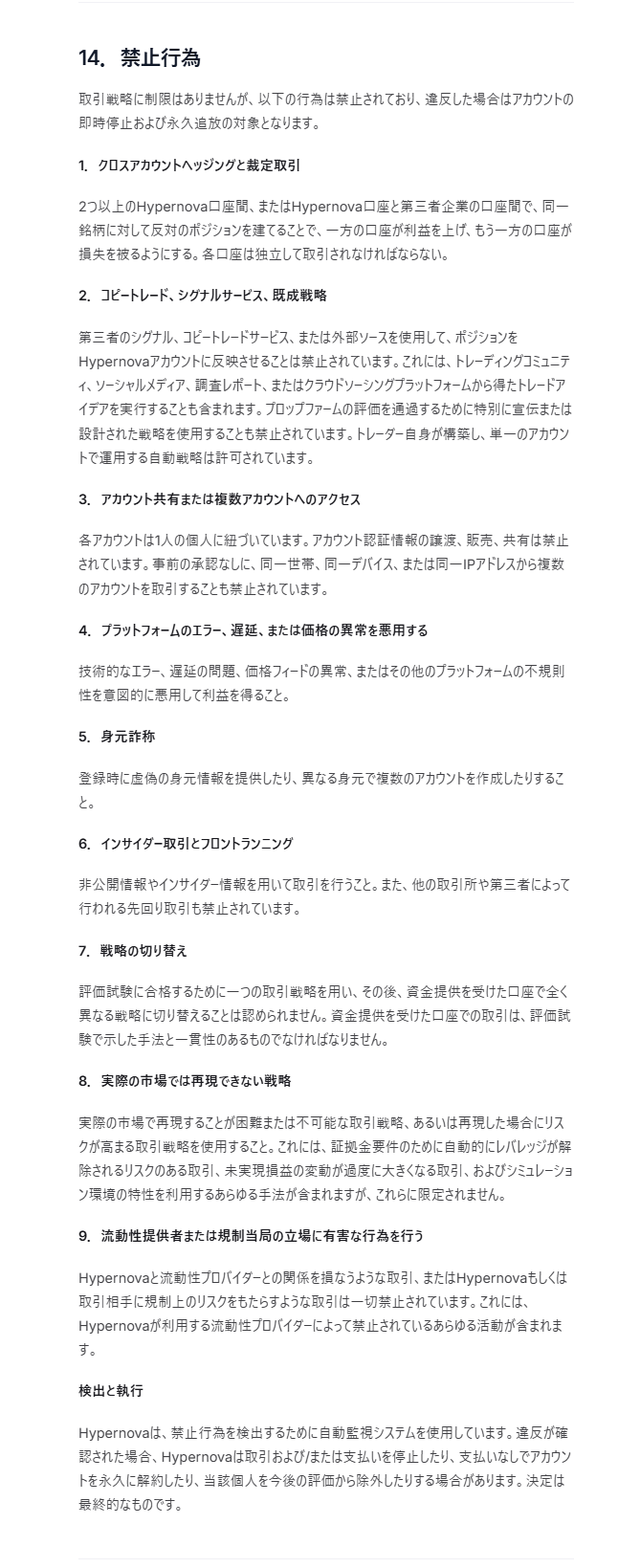
The page warns of immediate suspension and permanent exclusion. Its fuller Japanese text also prohibits selling/transferring/sharing credentials, multiple-account trading from the same household/device/IP without prior approval, exploiting delays or price anomalies, false registration identities and strategies marketed specifically to pass prop evaluations. It describes automated monitoring, possible trading/payment suspension, termination without payout and exclusion from future assessments. Read current account-specific terms directly.
Toreko: There seem to be quite a few differences from Propr.
USK: Yes. At the source date, Propr had conflicting passages about copying, while Hypernova explicitly banned copy trading, signal services and ready-made strategies. I did not see the same contradiction there. The frameworks may differ, so anyone using both should check each firm’s rules separately.
PR: Check Hypernova’s rules and USK’s invitation link. Daily invitation capacity may prevent registration; current availability is unverified.
17. Platform and profile
USK: USK observation: I checked Profile / Account Stats too. It collected lifetime results, and I found no inconsistency with the dashboard figures at the time.
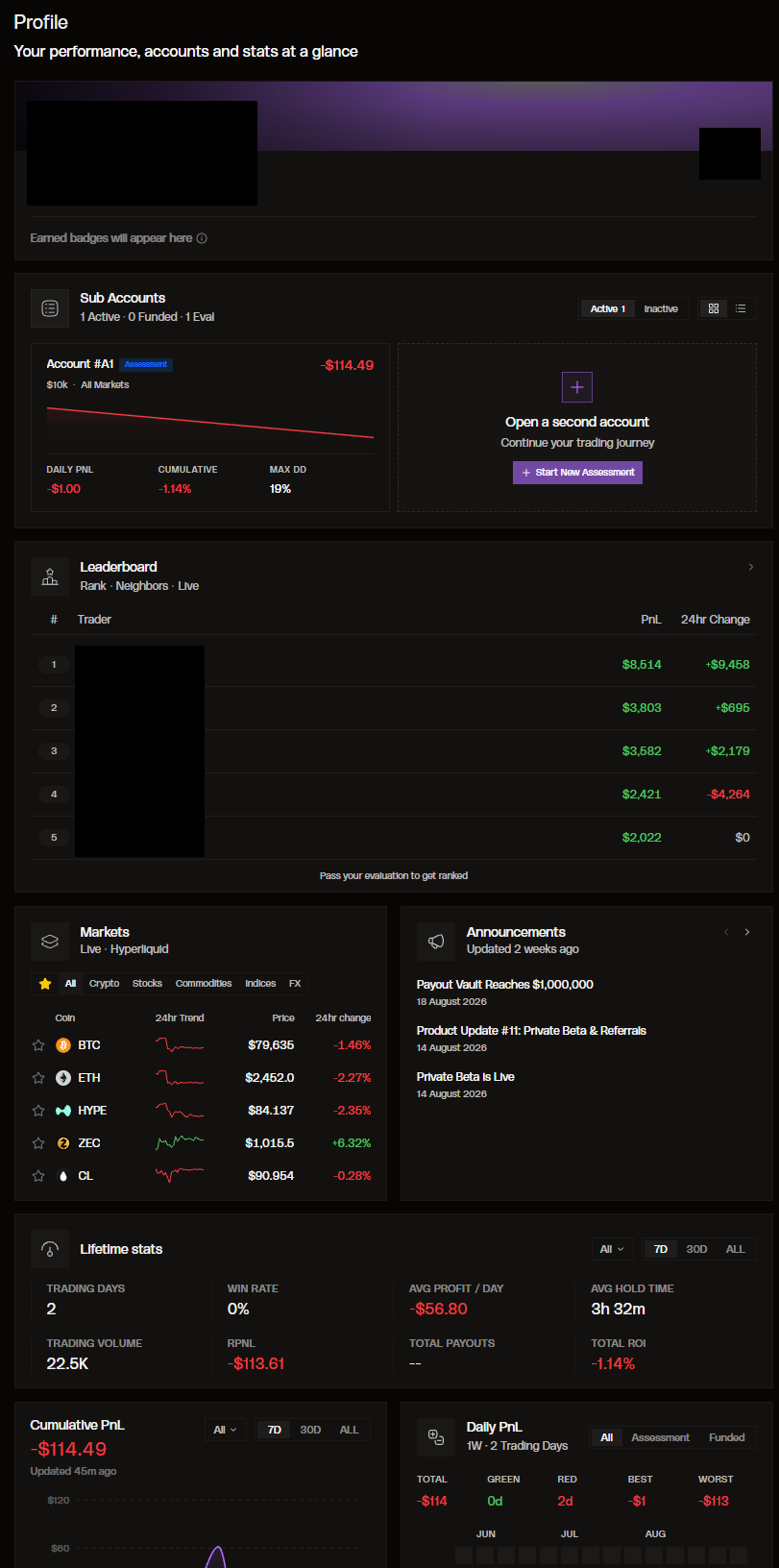
Actual Profile / Account Stats: account performance, lifetime statistics, markets and announcements. Personal profile identifiers and leaderboard identities are blacked out for privacy. The historical performance figures and all other screenshot pixels are unchanged. Slightly different time-specific displays are not an exact synchronized reconciliation.
18. My experience using it
USK: USK observation: honestly, because the platform was not natively Japanese, I initially used translation tools. Some wording was unnatural, but basic operations were not especially difficult.
Toreko: Didn’t the lack of Japanese support worry you?
USK: My view: people will feel differently about that. I found the pre-order HYPE and GOLD Fee displays attractive, although stock Taker fees in the source were higher than the Propr rates recorded in the source comparison. I’d consider total costs and usability as well as each instrument’s commission.
USK: I had started with Propr, which supported a Japanese UI, so I already knew the on-chain prop concept before trying Hypernova. That order probably helped. Someone starting directly with Hypernova may find the English interface and unusual terms a little confusing.
PR: Visit Hypernova through USK’s referral link. Registration is subject to availability; the source reported a daily invitation cap.
19. Advantages and drawbacks
Advantages recorded from official information and screen observations:
- The Payout dashboard displayed an average of 5.9 seconds, though USK had not timed a withdrawal personally.
- Pre-order Fee displays were consistent with the official Maker/Taker rates recorded at the time.
- A clear single Risk Tier axis for choosing drawdown strictness.
Points of concern within the source’s checked scope:
- Closed-beta invitation access, with rules and prices potentially changing after launch.
- Both target and loss triggers use equity; balance used to calculate the daily loss allowance must be distinguished.
- Earlier materials gave 99/140 markets; the current official Markets page lists 106, with availability subject to change.
These are the original assessment’s pros and cons, not a new ranking or proof of current payout performance.
20. Conclusion
USK: Hypernova is an on-chain prop firm distinguished by its own execution engine and Risk Tiers. In the screens I checked, pre-order Fee displays matched the published rates. I had not yet withdrawn, so actual arrival speed remained something I wanted to verify. Closed beta also left information gaps. I’d check the official site and Discord for the latest post-launch information before deciding.
About the referral link
The following is USK’s affiliate invitation link. The source reported a daily cap, so registration could be unavailable once the quota was reached. This translation does not confirm an open slot.
Visit Hypernova through USK’s referral link.
Terms used on this page
- Balance: Account balance reflecting realized P&L.
- Equity: Balance plus floating P&L on open positions: the account’s value right now.
- Daily Drawdown: Maximum loss permitted within one day.
- Max Drawdown: Maximum cumulative loss allowed from the account’s starting point.
- Risk Tier: Hypernova’s four levels, Tight/Low/Medium/High, balancing DD allowance and fees.
- Profit Target: The profit objective required to pass an evaluation.
- Maker/Taker: Makers supply liquidity with resting orders; takers consume it by executing immediately against existing orders. A limit order can be a taker if it executes immediately.
- Funding: Periodic adjustments exchanged between buyers and sellers in perpetual contracts.
- Execution Engine: The system deciding how orders are processed. Hypernova references Hyperliquid data while executing through its own engine.
- On-chain: Transaction or settlement records being on a blockchain and independently inspectable. The label alone does not mean every simulated trade is directly routed on-chain.
- Hyperliquid: The on-chain trading infrastructure used as Hypernova’s market-data reference.
- KYC: Know Your Customer: identity verification using documents and other required checks.
- Payout: Receipt of eligible profits after passing the assessment and trading a funded account.
Propr / Hypernova series
You are reading the Hypernova guide. Propr guide (Japanese): another hands-on review of a Hyperliquid-based prop firm. Propr vs Hypernova: a comparison of both services and whom they may suit.
FAQ
Is the Profit Target balance-based or equity-based?
Current Rulebook v1.4 uses equity including unrealized P&L. Touching the target triggers closing positions, canceling open orders and passing the assessment. Balance used to calculate the Daily DD allowance is a separate concept.
Can I trade Funded immediately after passing?
KYC must be completed and the Funded Trader Agreement signed with the wallet before activation.
Does a payout count as a Daily DD loss?
No. The day’s daily equity limit is lowered by the payout amount. Payouts require flat status, approved KYC, the initial waiting condition and a new round-trip trade between payouts; review holds can apply.
What kind of prop firm is Hypernova?
An on-chain-oriented prop firm with its own execution engine using Hyperliquid market data. The source’s official information described closed beta. Check current status directly; it does not directly route orders to Hyperliquid.
What are Hypernova Risk Tiers?
Tight, Low and Medium have defined target and drawdown parameters. High uses a 10% target, 5% daily loss and 8% maximum loss. It is Edition-only; sizes, fees, stock and end dates depend on the release.
What are the Maker and Taker fees?
The historical official table recorded Maker/Taker of 0.01%/0.04% for crypto, 0%/0.03% for stocks/ETFs and 0%/0.005% for commodities including Gold, indices and FX. USK’s HYPE and GOLD pre-order displays agreed with those rates. This did not check post-execution charges or stock order screens. The dedicated official Trading Fees page was directly rechecked for this November 12 JST update and agrees with those Hypernova rates. Verify applicability in your order screen.
How quickly does a Hypernova payout arrive?
The actual dashboard displayed a self-reported average of 5.9 seconds. USK did not time a withdrawal personally. It is not a promised processing or arrival time.
Can I start using Hypernova immediately?
At the source date, closed beta meant joining primarily through an invitation or waitlist. Check the official site and Discord for current access; the historical link does not guarantee availability.