

















Once you pass, when can you receive a payout? Can you keep using your usual trading methods? Knowing the failure threshold still leaves questions to answer before choosing an account. In Part 2, we look at payout conditions, EAs, trading around news, holding positions and the cost of trying again. As you read, compare the conditions with how you actually trade, so fewer things come as a surprise later.
Toreko: So once I pass, it’s finally time for a payout?
USK: Let’s check the payout requirements and which trading methods you can use, too.
If you have not read Part 1, start with the basics of drawdown and failure thresholds.
1. Passing and receiving a payout are separate
Toreko: I pass at JPY 1,100,000. Is the extra JPY 100,000 my payout?
USK: JPY 1,100,000 is the passing target. The payout has its own conditions.
In this teaching model, passing requires a balance of at least JPY 1,100,000, all positions closed and no DD breach. Some services call the process of receiving a reward a “withdrawal.” That does not mean you can withdraw the displayed account capital as cash. This article explains how to check whether you qualify for a payout; it does not calculate a payout amount.
After passing
For an actual product, the process often has several distinct steps: pass the evaluation, check the post-evaluation account conditions, meet the payout application requirements, apply and receive payment, then check the balance and loss limits again after payment.
The DD calculation method or allowance may also change after you pass.
Before applying
Before requesting a payout, check which profits qualify, the profit split (the share of eligible profit you receive), any waiting period, how often you can apply, the minimum amount, identity verification and payment fees.
Actual products may add minimum-day or consistency requirements. A consistency rule checks whether too much of your profit comes from a particular day or similar concentration. Check the formula, its denominator and the period it covers. Not yet meeting a condition, failing because of a breach, being temporarily suspended and being unable to request a payout are different states.

The comic in English: First check the value used to decide whether you pass, plus any additional requirements. Distinguish an unmet requirement from a breach, suspension or inability to apply. After passing, check DD, position-size limits and permitted methods again. For the payout, check eligible profit, the split, timing, amount, identity verification, payment method and fees. After receiving it, recheck the account balance and failure thresholds before placing another trade.
After receiving a payout
The sixth panel is about the period after payment and before the next trade. On the account screen, check the post-withdrawal balance, daily and overall maximum-loss thresholds, the remaining room above those thresholds, and the lot size (trade quantity) for your next order. Post-payout treatment varies by product. Rather than inferring it from our fictional figures, check the official rules and your account screen.
Keep passing requirements and payout requirements on separate lines in your notes, and check each against the official terms.
2. Can you use your usual trading methods?
Toreko: I sometimes place orders around news releases, and I’m also interested in EAs, the programs that automate trades.
USK: Then let’s list what you normally do and check each item against that product’s rules. A simple “trading allowed” label may not tell you enough.
Start with the methods you actually use. You can read the sections that match your trading, whether that means news releases, holding positions, EAs or copying trades.
Around news releases
“Execution” means an order has been filled. Around news, check separately whether the rules cover holding an existing position, placing a new order, closing a trade or having a pending order filled. The time you place an order and the time it executes may differ. Limit and stop orders are pending orders with specified triggering or price conditions.

The comic in English: Check holding a position, opening a new trade, closing a trade and execution as separate actions. Include limit and stop orders, as well as automatic exits, when checking what can execute during a restricted window. Match the official rules to the relevant announcement, instrument, minutes before and after the release, reference time zone and account stage. Do not assume that placing an order earlier makes its later execution permissible.
Short-term trading, EAs and copying
Scalping means trading over short periods. High-frequency trading (HFT) involves placing many orders in a short time. Even if a method is permitted, check minimum holding times and the firm’s definition of HFT separately.
- EAs: Check the conditions for the specific program, including whether it is your own code or commercially available software.
- Copy trading: This reproduces trades in another account. A signal is a trading instruction or piece of trading information. Check whether you are copying between your own accounts or copying someone else’s trades, whether positions run in the same or opposite direction, and which accounts the permission covers.
“EAs allowed” does not establish that every form of copying is allowed.

The comic in English: Read the minimum holding-time rule and HFT definition. Identify the EA or signal you want to use, the source and destination of copied trades, and whether the activity is inside one account or across accounts. Check how the rules define hedging and correlated instruments. Permission for one activity should not be extended to a different activity without checking.
Check the remaining conditions in three groups, based on how you plan to use the account:
- What and how much you trade: instruments, maximum position size and conditions for holding multiple trades at once.
- How long you hold positions: overnight and weekend holding, and mandatory closing times. Also check the time zone, daylight-saving time, inactivity deadlines (limits on periods without trading) and required trading days.
- Where access comes from, and who uses the account: connection methods, devices, country of residence and account-sharing rules.
Order types, simultaneous positions and connection terminology
- Limit order: an order intended to buy or sell at a specified price or better.
- Stop order: a pending order triggered when a specified level is reached. The execution price may differ from that level.
- Rules may refer to same-direction or opposite-direction positions. Hedging here means holding a buy and a sell in the same instrument at the same time; correlated instruments have related price movements. Check the scope of the firm’s definitions and restrictions.
- An IP address identifies a connection source; a VPN connects through another network. Check which connection methods are permitted.
Do not decide whether an activity is allowed or prohibited from its name alone. Apply the wording to the actual trades or connection method you intend to use.
When asking the firm, give the product name, account stage and a specific description of what you want to do. Keep the reply and the date you checked it.
Once you have checked your intended methods, consider the cost of continuing with your current account separately from the cost of starting again.
3. Costs, continuing and trying again
Toreko: My balance has fallen to JPY 970,000. If a fresh account needs less profit to pass, would buying again be better value?
USK: The difference in required profit isn’t enough to decide. Let’s compare the numbers on the same basis.
This example uses a separate account with a fixed overall loss threshold. Losses spread over several days have reduced the balance to JPY 970,000, and today starts with no open positions. There has been no previous DD breach. The overall threshold is JPY 1,000,000 minus JPY 60,000, or JPY 940,000. Opening balance and equity are both JPY 970,000, so the daily threshold is JPY 970,000 minus JPY 40,000, or JPY 930,000. That leaves JPY 30,000 above the overall threshold and JPY 40,000 above the daily threshold. These amounts are not a loss budget that it is safe to use in full.
If you continue, the profit needed to reach JPY 1,100,000 is JPY 1,100,000 − JPY 970,000 = JPY 130,000. Dividing by the current JPY 970,000 balance gives approximately 13.40% (rounded to two decimal places). Using the original JPY 1,000,000 as the denominator would give 13%. A new account on the same terms would need JPY 100,000 to move from JPY 1,000,000 to JPY 1,100,000. But the new account has a separate purchase cost, and progress from the old account does not transfer.
This teaching example does not set an actual selling price. To compare costs, use the same period and the same number of attempts. Include the purchase fee, tax and currency conversion, monthly renewals, trading costs, fees after passing, repurchase costs and the cost of a reset (a mechanism that restarts account progress). Also check platform and data charges, payout fees, and the terms for refunds, cancellation and automatic renewal.
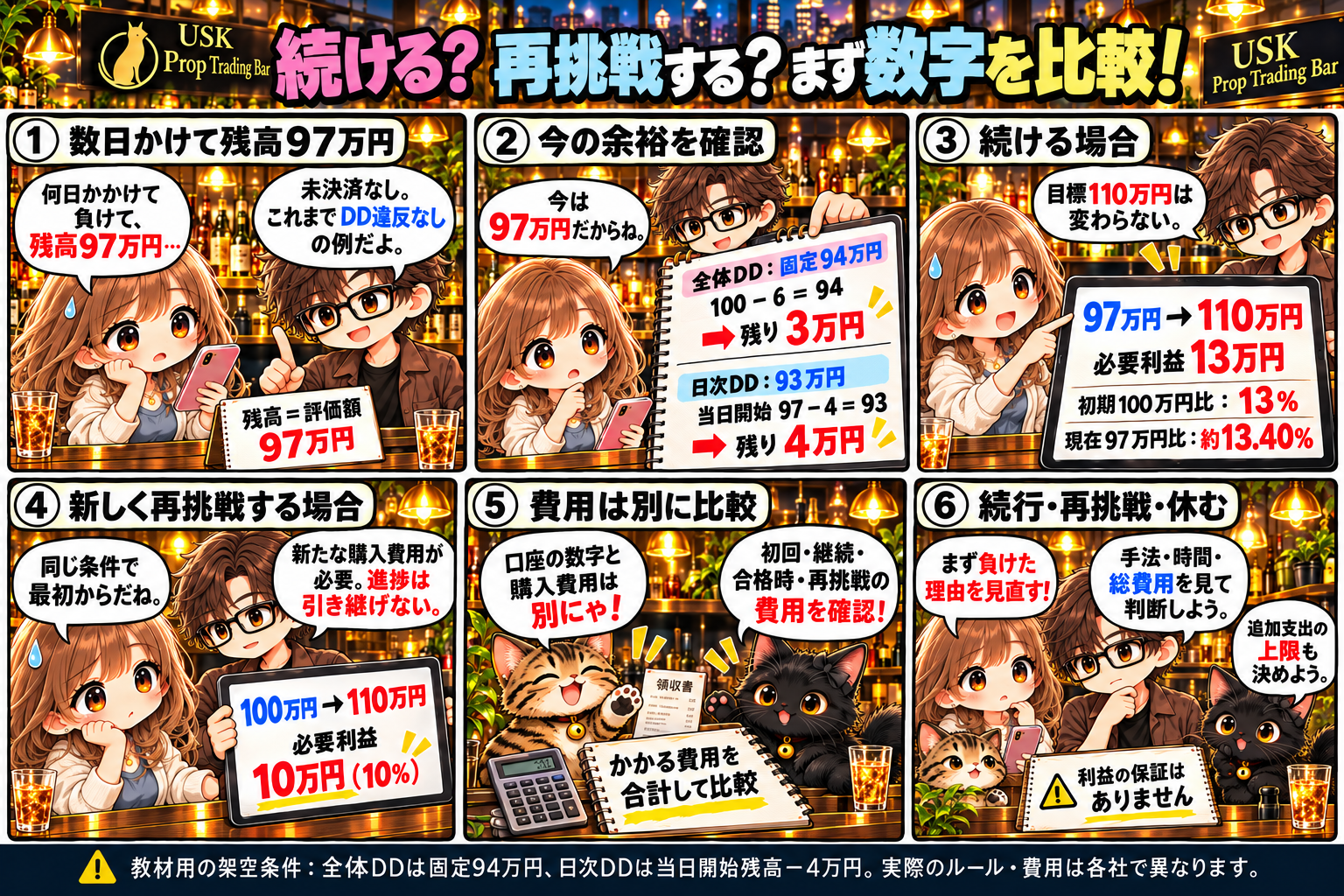
The comic in English: The original starting amount is JPY 1,000,000 and the target is JPY 1,100,000. Current equity of JPY 970,000 remains above both the JPY 940,000 overall threshold and the JPY 930,000 daily threshold. Continuing requires JPY 130,000 in profit, approximately 13.40% of the current balance. A fresh JPY 1,000,000 account requires JPY 100,000. The new purchase cost and the treatment of existing progress are separate considerations.
Compare continuing, buying again and taking a break in terms of your method, available time and total cost. Decide the maximum additional amount you are willing to spend first. This is a decision framework, not a recommendation to buy another account.
4. Before buying or using an account
Toreko: What should I check one last time before buying or starting to use an account?
USK: Let’s check your intended use and costs with these five items. Keeping the official page URL, check date, product and account stage makes it easier to review later.
- Trading-method conditions
- News-trading conditions
- Access and holding positions / Pre-trade DD checks
- Passing and payouts / After-payment checks
- Costs and retries
The checklist is optional; it does not save or send your answers. Check the official conditions for your product, account stage and applicable dates, and resolve anything unclear before using the account.
Check these five items against the official sources →
- Part 1: How much can an account lose before failing? explains balance versus equity and overall versus daily DD using a fictional JPY 1 million account.
- How to compare prop-firm accounts (Japanese) looks at choosing an account through actual use, payouts and rule checks.
Before buying, compare the product, account stage, costs and permitted methods with the official terms. Before trading, check today’s balance, equity, overall threshold, daily threshold and reset time, as well as whether that particular order is permitted. If you cannot explain a condition, clarify it before placing the order.
FAQ
Once I pass, can I receive all the profit made during the evaluation?
Not automatically. Eligible profits, application requirements and the account’s state after payment depend on the product. Check passing and payout requirements separately. See the payout section.
If EAs are allowed, is every kind of copy trading allowed too?
No. Check the specific EA, who is being copied and which accounts are covered. See trading-method restrictions.
Can buying another account add to the DD allowance of my existing account?
No. It is a separate account purchase and a separate attempt, not extra drawdown room for one account. See costs and retries.
Glossary
Execution: An order being filled. This does not necessarily happen at the time the order is placed.
Evaluation and challenge: The stage in which you demonstrate that you can meet specified requirements. It is separate from the account after passing and from receiving a payout.
Profit target: The profit requirement for passing or another milestone. Check whether it is measured using balance or equity, and how fees are treated.
Minimum trading days: The number of trading days needed to meet a condition. Check what counts as one day for the specific product.
Consistency requirement: A condition that checks concentration of profits in particular days or similar periods. The formula and measurement period matter.
Payout and profit split: A payout is a payment received after meeting specified conditions. The split is the proportion of the eligible amount that you receive.
EA: A program that automates trading. The permitted uses depend on the product.
Copy trading: Reproducing trades from another account or signal. The source and destination of those trades also affect which rules apply.
Scalping and HFT: Terms for short-term or small-price-move trading and high-frequency trading. Check the firm’s exact definitions of permitted and prohibited activity.
Reset and repurchase: Restarting an account’s progress, and purchasing a new account, respectively. Availability, fees and treatment of progress depend on the product.
Official clarification on effective dates
See the official FX/CFD references by plan in Part 1.
Do not apply this model’s 10% target, 6% overall allowance or 4% daily allowance to actual firms. Check the relevant plan and the conditions applicable to its dates. The Japanese source article records its reference check as October 15, 2026 (JST). The following example preserves that dated account of the official information, rather than asserting a fresh verification on November 6.
FTMO effective-date example and its sources
According to the Japanese article’s October 15 reference check, FTMO announced a change from the Best Day Rule to the Consistency rule for new orders for the 1-Step FTMO Challenge created from October 12, 2026 at 09:00, MetaTrader GMT+3 as specified in its announcement. “Orders” here means purchases of a Challenge, not buy or sell orders placed in a trading account. FTMO Accounts (1-Step) merged on or after October 12, 2026 were also described as covered by the change.
For accounts originating from eligible orders before that boundary, the article reports that merely passing or receiving a payout did not switch them from the old rule. Not yet meeting the condition was not described as an immediate breach; the intention was that it could be met through additional trading.
This example concerns the particular FTMO product and dates stated above. It should not be extended to 2-Step accounts or other firms. Check the current formula and its applicability to your own purchase or account-merger date directly with FTMO.
Official-page reference date recorded in the Japanese article: October 15, 2026 (JST). Current wording and applicability should be checked before relying on this example for a purchase or trade.
Before buying, record the conditions for your own account and the date you checked them. Use official information for anything that may change.
For readers considering their first Fintokei purchase, the StartTrader introductory-plan guide (Japanese) explains participation conditions and loss rules through conversations and diagrams.