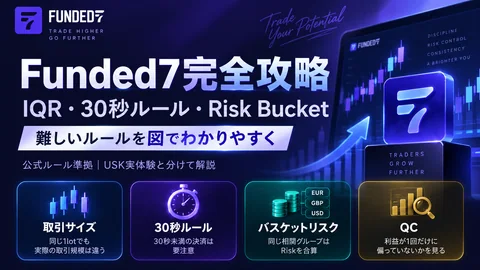












Independent guide by USK. This English edition follows the Japanese article updated on November 11, 2026, including the latest MT5 walkthrough. Official pages were checked again for this translation. Differences in SL timing, cross-symbol netting, PAYG drawdown and tier scope are identified below. Affiliate links are included; USK may receive a commission. Passing an evaluation, receiving a payout and making a profit are not guaranteed.
Introduction: Funded7 makes less sense when you read each rule in isolation
Hi, USK here.
Coupon update
November 11, 2026: the 90% discount on PAYG Phase 1 using uskpayg90 ended at the end of October 2026. It is not presented as an active offer.
I have used Funded7 for a while and have received payouts. But simply checking the profit target and maximum loss does not tell you much about what makes its rules difficult to follow.
The complication comes from several checks working together: trade-size consistency, median and IQR, profit quality (QC), qualifying trades, the timing of stop-loss placement, very short holding periods, tier-specific risk limits and the review attached to each payout request.
This guide explains what to look at in Funded7’s public rules. I have also made a separate, independent tool for reviewing trade-size variation in your own MT5 history: open the MT5 self-diagnostic.
VIDEO GUIDE
Start with the overall picture
An overview of notional value, the two 30-second checks, risk groups and QC.
Original Japanese video. Japanese narration and on-screen text. English explanation follows below. Press the central Play button to load and start the video at low volume. You can change the sound and volume at any time.
1. Start with the standard Two Phase challenge
The basic conditions come first. These are for the standard Two Phase plan, not a promise that every plan or funded tier uses the same settings.
Standard Two Phase: basic conditions
| Item | Published condition |
|---|---|
| Phase 1 profit target | 8% |
| Phase 2 profit target | 6% |
| Daily loss limit | 5% |
| Maximum total loss | 10%, static |
| Minimum trading days | 3 |
| Minimum closed trades | 10; qualifying-trade requirements also apply |
| Standard profit split | 80% to the trader / 20% to the firm |
| Payout request interval | Every 7 days, subject to eligibility and review |
| Minimum payout received | $100 after the split |
Source: Funded7 Challenge Comparison. See the payout section for timing and the minimum amount.
Once you reach the funded stage, OREF, the Optimal Risk Enforcement Framework, governs the review of trading activity and assignment to Standard Funded, Silver or Bronze. Basic plan conditions, open-risk limits and asset-specific leverage must be read separately. Official OREF overview.
PAYG needs a separate check
The current comparison page and an older official guide give different PAYG drawdown figures. The comparison lists 5% daily / 10% total, while the official challenge guide lists 4% / 8% static.
This guide therefore does not choose one fixed PAYG daily or maximum loss limit. Confirm the terms for your particular account with Funded7 before relying on either figure.
 Funded7 Official website (Japanese checkout) Check the current plan and account conditions. View Funded7 plans →
2. Rule 1A: notional value, median and IQR
VIDEO GUIDE
Rule 1A: a visual introduction
How the centre and spread of trade sizes relate to the upper threshold.
Original Japanese video. Japanese narration and on-screen text. English explanation follows below. The definitions, calculation convention and limitations are explained below.
First, Funded7 looks at notional value, not just lots
The important question is not simply how many lots you traded, but how much market exposure the trade represented.
Even on the same instrument, a large price move can change notional value while the lot count stays the same.
- 01Instrument and contract size
- 02Lot size and execution price
- 03Currency conversion where needed
- 04Comparable notional value
A fixed lot count does not necessarily mean fixed notional exposure.
What is the median?
The median is the middle value after sorting the observations from smallest to largest. Here is the same illustrative dataset used in the Japanese article:
20 / 30 / 30 / 40 / 50 / 60 / 60 / 70Units are omitted to make the example easier to follow. In the actual rule, the observations are notional values.
There are eight observations, so the middle pair is 40 and 50. Their average is (40 + 50) ÷ 2 = 45. In this example, the centre of the usual trade size is about 45.
- 0120 · 30 · 30 · 40
- 0250 · 60 · 60 · 70
- 03Middle pair: 40 and 50
- 04Median: 45
What are Q1 and Q3?
Q1 is the 25th percentile; Q3 is the 75th percentile. The idea of the lower and upper parts of the data helps build intuition, but “the median of each half” is not a universal definition of a quartile.
This article uses Hyndman–Fan Type 7, the method used by Excel’s QUARTILE.INC / PERCENTILE.INC and the illustrative calculations in the MT5 tool. For this dataset, Q1 = 30 and Q3 = 60.
What is IQR?
IQR = Q3 − Q1 = 60 − 30 = 30.It describes the spread of the central 50% of observations. Here, that middle portion lies between 30 and 60.
- 01Q1: 25th percentile = 30
- 02Q3: 75th percentile = 60
- 03IQR: 60 − 30 = 30
Type 7 is the convention used for this example, not a confirmed specification of Funded7's internal implementation.
IQR is not the upper limit
The IQR itself is 30. The IQR Criterion uses it to calculate a different number:
Q3 + 1.5 × IQR = 60 + 1.5 × 30 = 105.So 30 is the measure of spread; 105 is the upper reference calculated from it.
The median produces a second criterion
The Median Criterion = median × 2.5 = 45 × 2.5 = 112.5.
Funded7’s Rule 1A takes the lower of the two criteria as its allowable threshold:
- 01Median Criterion: 112.5
- 02IQR Criterion: 105
- 03MIN(112.5, 105) = 105
In this worked example the threshold is 105. It is not the IQR value of 30.
Source: Funded7 Rule 1: Payout Criteria.
The sequence is: find the median, calculate the IQR, calculate both criteria, then use the lower one.
Why fixed lots are not a safe shortcut
The same lot count can mean different exposures in FX, gold, indices and crypto. Even for gold alone, a price change can alter the notional value of 1.00 lot.
- 01Gold trade A: 1.00 lot
- 02Gold trade B: 1.00 lot
- 03Different execution prices
- 04Different notional values
Illustration only. Fixing lots is not the same as fixing notional exposure.
The calculation is only part of the review
Passing a median/IQR calculation does not guarantee that Funded7 will approve an account or payout. Qualifying trades, trade clusters, QC, risk conditions and the Risk Team’s review also matter.
About this worked example
The quartiles use Type 7 consistently. The official page publishes the median/IQR criteria but does not confirm that exact quartile algorithm. This example and USK’s tool do not reproduce Funded7’s final review.
3. Ten closed trades does not mean any ten trades will count
The published requirements include at least 10 qualifying closed trades and 3 active trading days. A day with a new order or a closure can count as active.
Funded7 considers unusually short holding periods relative to your normal trading, negligible account impact and end-of-window placement together, rather than treating any one factor as decisive. Trades added purely to reach the count, particularly after the target, receive additional scrutiny.
That distinction matters to me. A “Pass” shown by the system does not necessarily mean the review is final. Funded7 retains the right to examine the trading later. Sources: Qualifying Trade FAQ and Rule 1.
4. There are two different 30-second rules
VIDEO GUIDE
Separate stop-loss timing from trade duration
One check concerns when an SL is placed. The other concerns how quickly trades are closed.
Original Japanese video. Japanese narration and on-screen text. English explanation follows below. The original Japanese video describes the interpretation used by the Japanese article. Read the current official-wording caveat below before relying on it.
A. The timing of stop-loss placement
The Japanese article explains SL-based risk when a valid stop loss is present at entry or confirmed within 30 seconds. Without a valid SL in that interval, it describes ATR-based risk remaining in place even if the first SL is added later.
SL-based risk = |entry price − SL price| × lots × contract size × FX conversion.ATR-based risk = ATR(14) × 1.96 × lots × contract size × FX conversion.The published ATR(14) timeframe is Daily (D1). In the contract-size formula above, ATR is expressed in price units. The conversion factor is needed when the calculation currency differs from the account currency. These are explanations of monetary exposure, not a reconstruction of the Risk Team’s complete calculation.
Current official wording is inconsistent
The English Rule 2 & 3 page mentions an MT5-only 30-second placement buffer, but also says SL-based risk applies only when the SL is submitted with entry and that an SL added after execution leaves ATR risk in place. It does not consistently establish whether a stop added within 30 seconds qualifies. Do not assume a late SL guarantees SL-based calculation. Confirm your platform and account treatment with Funded7; placing the SL with entry avoids relying on that ambiguity.
- 01SL timing: which risk method applies?
- 02Trade duration: how many exits are ultra-short?
The placement buffer is described as MT5-only. It is not a universal 30-second exemption for every platform.
The original gold example uses 1 lot, a 100-ounce contract, ATR(14) of $50 and USDJPY of 150. The reference gold price is about $4,000, but price does not replace ATR in this risk formula:
50 × 1.96 × 1 × 100 × 150 = ¥1,470,000.These are illustrative assumptions, not live prices or verified contract settings for your account.
B. The duration of the trade
The execution-standard thresholds concern the proportion of all trades:
- Trades closed in less than 15 seconds: a violation if they exceed 2% of the total trade count.
- Trades closed in less than 30 seconds: a violation if they exceed 3% of the total trade count.
This is not a fixed “one quick exit equals automatic failure” rule. A single short trade can still exceed the percentage when the total count is small.
Profits from violating trades may be voided. Tier restrictions can also apply; serious or repeated violations can bring more serious consequences. Losses do not disappear. The OREF overview and individual FAQs differ on some enforcement details, so do not turn this summary into a guarantee about the outcome of a review.
5. Check simultaneous open risk, not just a daily percentage
VIDEO GUIDE
Risk buckets and the whole account
How risk adds up within a correlated group and across the portfolio.
Original Japanese video. Japanese narration and on-screen text. English explanation follows below. The examples are explanatory. Your account's applicable limits and the official review take priority.
Funded7 groups related instruments into Risk Buckets. OREF’s Flat Risk Limit applies to single positions, correlation buckets and the total portfolio.
Do not confuse that simultaneous-risk limit with the plan’s separate daily drawdown limit. Both can matter. Also, do not mix older private support messages into today’s public rules: I have not established a general current rule such as “margin usage below 60%” or “no more than six same-direction positions in one symbol.”
Rule 2C: add risk within the same bucket
In the official standard Pro/Funded example, EURUSD risk of 1.6% and GBPUSD risk of 1.5% are both in Bucket 1, labelled “USD Long Correlation.”
- 01EURUSD risk: 1.6%
- 02GBPUSD risk: 1.5%
- 03Bucket 1 total: 3.1%
- 04Above the example's 3.0% limit
Splitting exposure between different symbols does not create separate allowances if they belong to the same bucket.
Rule 2D: add risk across the account
Bucket 4 at 2.0% and Bucket 10 at 1.5% are individually below a 3.0% limit. The portfolio total, however, is 3.5%.
- 01Bucket 4: 2.0%
- 02Bucket 10: 1.5%
- 03Portfolio total: 3.5%
- 04Above the example's 3.0% limit
Different buckets are not completely independent risk budgets. The account-level check still applies. Source: Rule 2C & Rule 2D Classification List.
View all 19 risk buckets
Funded7 risk-bucket classification
| # | Bucket | Instruments |
|---|---|---|
| 1 | USD Long Correlation | EURUSD, GBPUSD, NZDUSD, AUDUSD |
| 2 | USD Short Correlation | USDJPY, USDCHF, USDCAD |
| 3 | EUR Crosses | EURGBP, EURCHF, EURCAD, EURAUD, EURNZD |
| 4 | JPY Crosses | GBPJPY, EURJPY, AUDJPY, CADJPY, CHFJPY, NZDJPY |
| 5 | GBP Crosses | GBPCHF, GBPCAD, GBPAUD, GBPNZD |
| 6 | Commodity Crosses | AUDCAD, AUDNZD, CADCHF, NZDCAD, NZDCHF, AUDCHF |
| 7 | USD Exotics | USDCNH, USDCZK, USDHKD, USDHUF, USDMXN, USDNOK, USDPLN, USDSEK, USDSGD, USDZAR |
| 8 | EUR Exotics | EURCZK, EURHKD, EURNOK, EURPLN, EURSEK |
| 9 | Other Exotics | AUDSGD, SGDJPY |
| 10 | Metals | XAUUSD, XAGUSD, XPDUSD, XPTUSD |
| 11 | Oil & Energy | USOIL, UKOIL |
| 12 | Natural Gas | NATGAS |
| 13 | US Large-Cap Indices | US500, US30, US100 |
| 14 | US Small-Cap Indices | US2000 |
| 15 | European Indices | GER40, UK100, FRA40, EU50, ESP35, ITA40, SWI20 |
| 16 | Asia-Pacific Indices | JPN225, HK50, AUS200 |
| 17 | Major Crypto | BTCUSD, ETHUSD |
| 18 | Altcoins | XRPUSD, LTCUSD, SOLUSD, BNBUSD, BCHUSD |
| 19 | Dollar Index | USDIDX |
Long and short positions in the same symbol
The classification page offsets longs and shorts in the same instrument, then sums each instrument’s net risk within a bucket. The broader Position Risk page instead describes offsets within the same bucket.
Those descriptions are not equally specific. I would not assume that buying EURUSD and selling GBPUSD necessarily cancels the risk. Confirm cross-symbol netting with Funded7 rather than building a risk plan around an unresolved interpretation.
6. Profit quality also has an outlier check: QC
VIDEO GUIDE
QC and trade clusters
Why one unusually large win and several nearby orders can matter to the review.
Original Japanese video. Japanese narration and on-screen text. English explanation follows below. This explanation does not reproduce the final Risk Team assessment.
Rule 1C examines whether profits are concentrated in one unusually large win:
QC = (second-largest profit + third-largest profit) ÷ largest profit.The published requirement is QC ≥ 0.90. The point is to avoid a record with one exceptional win and very small profits everywhere else.
- 01Add the second- and third-largest profits
- 02Divide by the largest profit
- 03Required QC: at least 0.90
Nearby positions opened in the same instrument can be grouped into a Trade Cluster and treated as one trade for this calculation. Splitting a large order is not a reliable way to produce separate qualifying wins. Official Rule 1C.
7. Keep challenge conditions, funded risk limits and leverage separate
Now apply the rules to the correct stage and tier.
A. Standard Two Phase evaluation conditions
The basic plan table covers the standard Two Phase evaluation. Its challenge leverage specifications are separate from the Funded-tier table below. For example, the official comparison currently lists Two Phase spot metals at 1:50, while standard Funded metals in OREF are 1:10. Do not apply a funded table to every evaluation account.
B. Funded-tier open-risk limits and stop losses
Funded stage: simultaneous open risk
| Funded tier | Flat Risk Limit | Stop loss |
|---|---|---|
| Standard Funded, also called Pro / Gold | 3.0% | Optional in the tier table; recommended |
| Silver Funded | 2.0% | Mandatory |
| Bronze Funded | 1.0% | Mandatory |
These limits apply to single positions, correlation buckets and the total portfolio. They are not daily loss limits. “Optional” does not mean risk is ignored: ATR-based treatment still matters when an eligible stop is absent.
C. Funded-tier leverage by asset class
Funded stage: leverage by asset class
| Funded tier | FX | Indices and metals | Crypto |
|---|---|---|---|
| Standard Funded | 1:50 | 1:10 | 1:3 |
| Silver Funded | 1:30 | 1:5 | 1:2 |
| Bronze Funded | 1:20 | 1:5 | 1:2 |
Source for both tables: Rule 2 & 3: Position Risk & Execution, checked for this English edition on November 11, 2026.
English-edition clarification: the Japanese source diagrams grouped “Gold Pro / Challenge” together and reversed the Silver/Bronze values under the crypto and metals/indices headings. This edition separates the stages and follows the official Funded table above. The Japanese article also recorded a Bronze FX discrepancy of 1:20 versus 1:30 across official material; the cited Rule 2 & 3 table gives 1:20. Confirm the settings applied to your actual account.
USK-specific coupon information
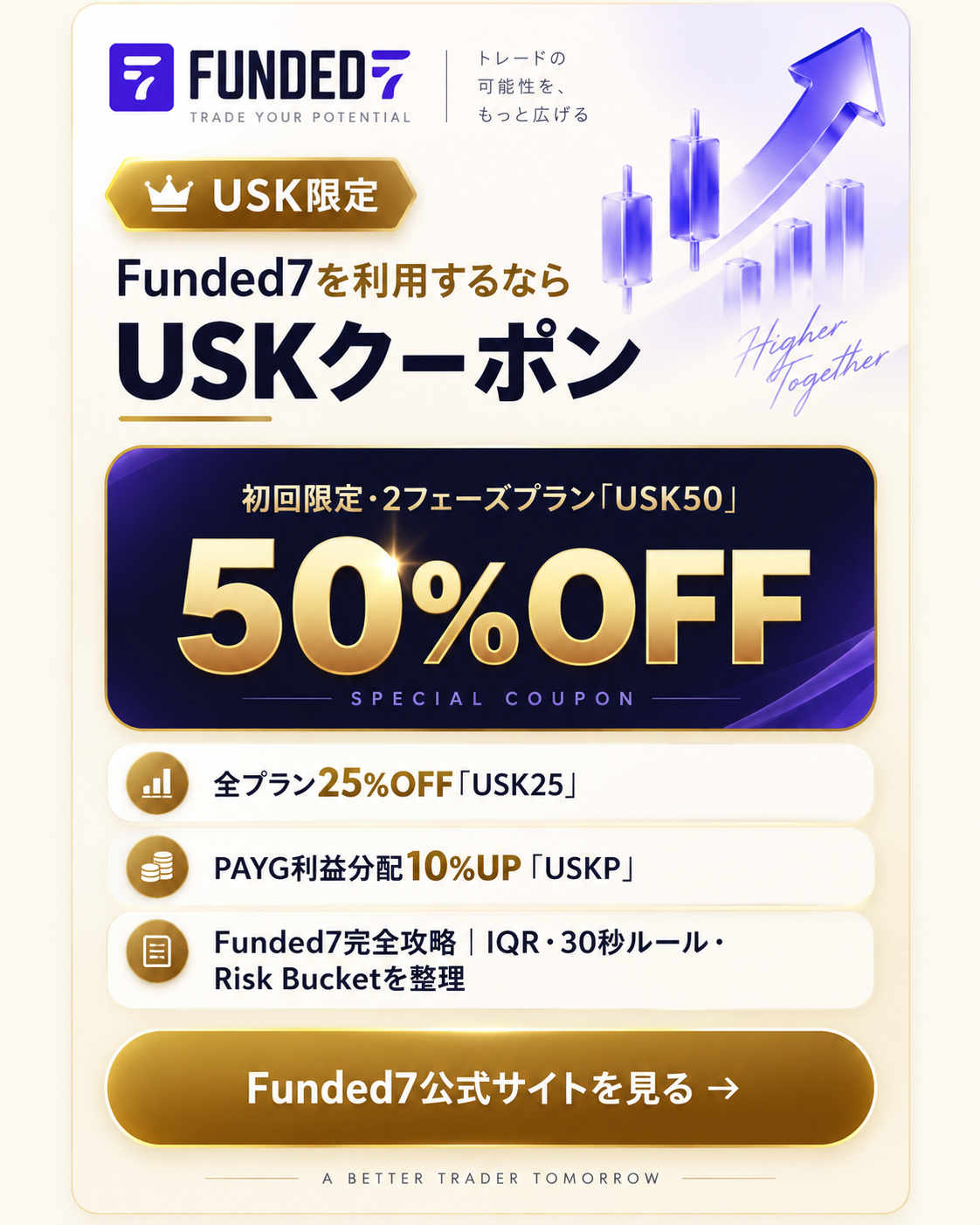
The Japanese source presents the following USK-specific offers. They are information provided by USK, not a claim that these codes have been independently verified in today’s checkout. Eligibility, resulting profit split, expiry and combination rules must be checked before purchasing.
USK50: first purchase of a Two Phase challenge, as described in the Japanese source.
USK25: described in the source as applying across plans. Check eligibility at checkout.
USKP: the PAYG profit-share offer described by USK, not a purchase-price discount. Confirm the resulting split.
The expired uskpayg90 offer is not one of the codes listed above.
Funded7 Official website (Japanese checkout) Verify eligibility, the actual discount and the final account conditions before buying. Check current account conditions → 8. How do Silver and Bronze move back to standard Pro?
The OREF overview describes an upgrade after three successful payouts. The dedicated ranking FAQ adds an important condition: a payout window with a violation does not count toward ranking up, even if a payout was received.
The safer reading is three clean payouts. The overview says they do not need to be consecutive. Do not count receipt alone as proof that a payout qualifies for promotion.
Sources: OREF overview and dedicated ranking FAQ.
9. Payout requests are available every seven days, with review
The payout FAQ describes eligibility every seven days from account creation or the previous withdrawal. It also states:
- The minimum amount received is $100 after the profit split. At 80/20, this means $125 in gross eligible profit.
- Submitting a payout request automatically closes all open trades. Check your positions before submitting.
- The account is read-only during processing.
The review examines the payout window since the previous successful payout. Minor breaches may result in only the relevant profits being voided, with a payout still possible if the remaining eligible amount meets the minimum. That is not a guarantee of approval.
Serious Rule 4 breaches, or serious or repeated violations, can result in a rejected payout or account termination. The broad OREF overview and the specific payout-review FAQ differ in how they describe strikes for minor breaches. Avoid assuming every case has the same result.
Sources: Payout FAQ, payout-review FAQ and Rule 4.
A successful payout starts the next review window; a rejected request leaves the same window continuing.
If you are considering Revolut as the receiving account, see my Revolut guide (Japanese). My experience receiving Funded7 and FundedElite payments is a personal record, not a guarantee that every account or transfer will be accepted.
Funded7 Official website (Japanese checkout) Review the current account and payout terms. Visit Funded7 → 10. The review happens at different stages
Phase 1: profit target, drawdown, minimum trading days and minimum closed trades are checked. Qualifying-trade eligibility can be reviewed later.
Phase 2: reaching the target leads to a manual Risk Team review. Under OREF, a Rule 1 consistency miss can lead to Silver Funded rather than a simple fail. This does not override serious prohibited-strategy or risk breaches.
Funded stage: each payout window is subject to a compliance review. Broadly, a Rule 1 miss can lead to a payout hold; Rule 2/3 breaches can lead to voiding the relevant profit and tier restrictions; serious Rule 4 breaches can lead to termination.
These categories explain the different types of outcome, not an automatic decision tree for your account.
11. “The same lot size” does not mean “consistent exposure”
The main checks work across notional value, median, IQR, contract size, SL-based or ATR-based risk, correlation buckets, portfolio risk, QC and trade clusters.
That is why “I normally trade 0.10 lot, so another 0.10 lot must be fine” is not enough. This matters especially when moving between FX, gold and indices.
- 01Notional trade size
- 02Applicable risk calculation
- 03Correlated bucket exposure
- 04Total portfolio and payout review
12. Want to review your own trade sizes? Try the MT5 self-diagnostic
If you are wondering how much your own trades vary, I have made a separate MT5 Trade-Size Self-Diagnostic.
Save an HTML report from MT5’s Positions history view. The tool compares the monetary size of closed positions using notional values in USD or JPY. Its standard estimate uses current Funded7 specification candidates and a recent two-week average exchange rate. You must check whether those specifications apply to your account and symbols. Manual specification and exchange-rate entry are also available.
The output includes:
- Closed-position notional values in the selected comparison currency.
- Median, Q1, Q3 and IQR.
- The lower of median × 2.5 and the IQR upper criterion.
- The largest notional value and the number of observations above the chosen threshold.
Individual mode treats each closed-position row as one observation. Grouped mode combines uninterrupted exposure in the same symbol and direction until it returns to zero. If the report identifies USD or JPY as the account currency, that is initially selected for comparison.
Current specification candidates and recent average FX rates do not establish the historical conditions at the time of each trade. If required specifications or currency conversions are unknown, the tool does not silently guess and continue.
This is an independent USK reference tool
The tool is not provided, reviewed or approved by Funded7. It cannot tell you whether you officially violated a rule, and it does not reproduce the Risk Team’s qualifying-trade, cluster, notional-value or review decisions. We have not confirmed that the tool’s complete methodology is identical to Funded7’s official assessment.
USK TOOLS · VIDEO GUIDE · 3:48
How to use the self-diagnostic tool
A 3-minute 48-second walkthrough: prepare the HTML report, check the settings and read the sample results.
Japanese explanation first, followed by the same walkthrough in English from 2:14, with on-screen captions. Open the video
The screens are explanatory samples. Some colours differ from the current interface. The MT5 save dialog is not shown; follow the written export steps in the diagnostic article.
This is an independent USK tool, not provided, reviewed or approved by Funded7. Results are for reference, not an official assessment. Tool questions: contact USK (Japanese form)
Music: “Clear Skies” by Scott Buckley · CC BY 4.0
Edited and mixed with narration for this walkthrough.
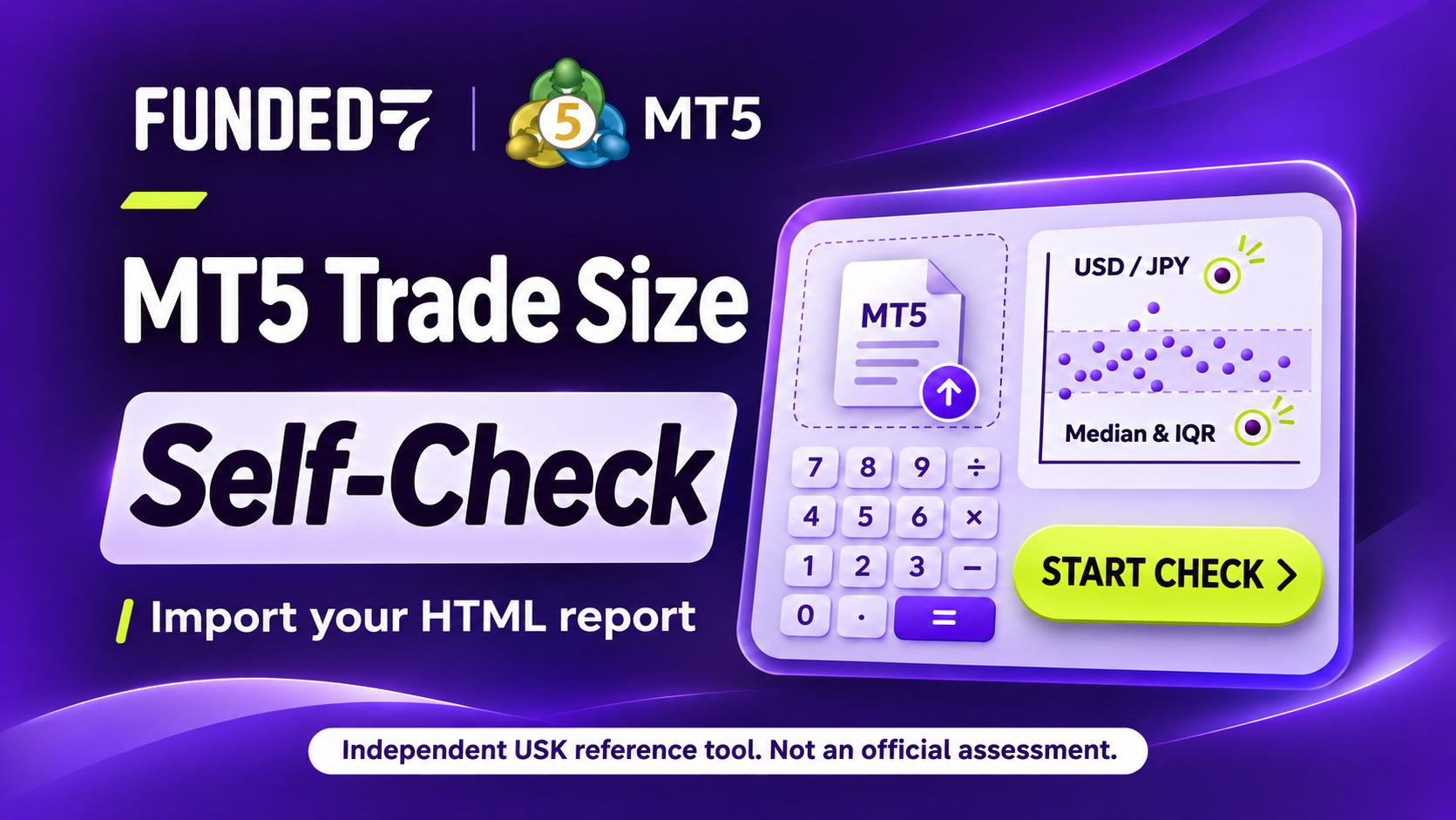
Import an MT5 HTML report, check the settings and compare your trades. You can try a fictional sample before using your own report.
Open the English self-diagnostic →History parsing and calculations happen in your browser. Trade history and account information are not uploaded or stored by this tool. When using average exchange rates, it fetches public FX data. Tool questions should go to USK through the contact form (Japanese), not Funded7 support.
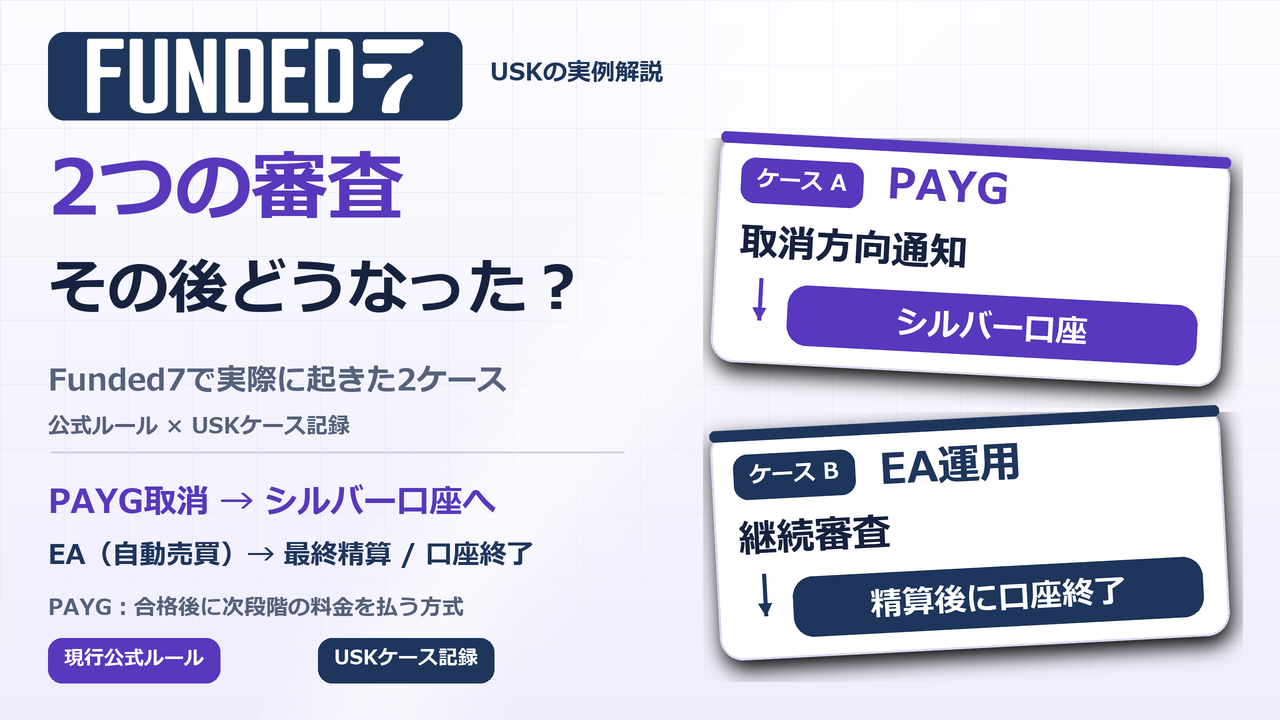
13. My PAYG case belongs in a separate article
I previously had a detailed exchange with Todor about a PAYG assessment. It covered excluded qualifying trades, Rule 1, Rule 4, Phase 1 and Phase 2, the timing of PAYG review, official clarification and the eventual assignment of Silver Funded.
The final outcome validated Phase 1 and Phase 2 and granted Silver Funded. Explaining why the initial decision changed would take this guide away from its main purpose, so that history is a separate story.
Here, I keep past company replies about my individual case separate from current published rules.
14. My takeaway: do not judge Funded7 by one number
“Maximum loss is 10%,” “just watch the 30-second rule,” or “keep the lots the same” does not cover the full picture.
The points I would check are Rule 1A’s notional values and median/IQR criteria, QC, qualifying trades, the two separate timing checks, simultaneous open-risk limits and the review attached to each payout request.
At the same time, I do not think every rule needs to become a reason to stop trading out of fear. The practical idea is to notice when a trade departs sharply from your usual approach, and to understand the account-level exposure before adding it.
Funded7 Official website (Japanese checkout) Check the current challenge list and account sizes. Explore Funded7 plans → Funded7 Official website (Japanese checkout) Read the conditions before creating an account. Open the registration page → FAQ
Does Funded7 really use the median and IQR?
Yes. Public Rule 1A explicitly gives median- and IQR-based criteria. They are only part of the assessment; notional value, qualifying trades, clusters and the Risk Team review also matter.
Is exceeding the IQR itself a violation?
No. The IQR itself is not the upper threshold. The rule compares median × 2.5 with Q3 + 1.5 × IQR and uses the smaller result. In the example, IQR is 30, the IQR Criterion is 105, the Median Criterion is 112.5 and the allowable threshold is 105. A calculation here is not an official verdict.
Do different symbols have separate risk allowances?
Not necessarily. EURUSD and GBPUSD are both in Bucket 1, so their risk is considered together under Rule 2C. Do not assume that opposite positions in different symbols offset without clarification.
Are different buckets completely separate?
No. Rule 2D also checks total portfolio risk. Individual buckets can each be within their limits while the combined account risk exceeds its limit.
Does one trade shorter than 30 seconds disqualify me?
The published execution rule uses percentages: more than 2% under 15 seconds or more than 3% under 30 seconds. One trade can still cross a percentage threshold if the total sample is small. This is separate from stop-loss placement timing.
Am I safe if I always trade the same lots?
Not necessarily. Contract sizes, prices and instruments change what those lots represent. Rule 1A looks at notional exposure, and other risk and review rules still apply.
Can the USK tool tell me whether I officially broke a rule?
No. It is a statistical aid for reviewing your own history. Current specifications and recent average FX provide an estimate, with manual input also available. Neither mode is Funded7’s official violation test or final Risk Team judgement.
What happened in the PAYG dispute?
In my case, Phase 1 and Phase 2 were ultimately accepted and Silver Funded was granted. The detailed history includes past case-specific company replies, so it should not be treated as today’s general rule.
The Japanese article’s original rule-research date was September 20, 2026. This English edition uses its November 11, 2026 revision and checks the linked English primary sources on November 11, 2026. Rules, plans and offers can change. Source conflicts remain conflicts until the company clarifies them.
Disclaimer
This article explains USK’s experience and understanding of published information. It is not financial advice and does not guarantee evaluation success, payouts or profits. Make trading and challenge-purchase decisions at your own risk. Check the latest terms and any account-specific instructions with Funded7. The MT5 tool is an independent statistical reference for reviewing historical trade-size variation, not an official Funded7 assessment.