















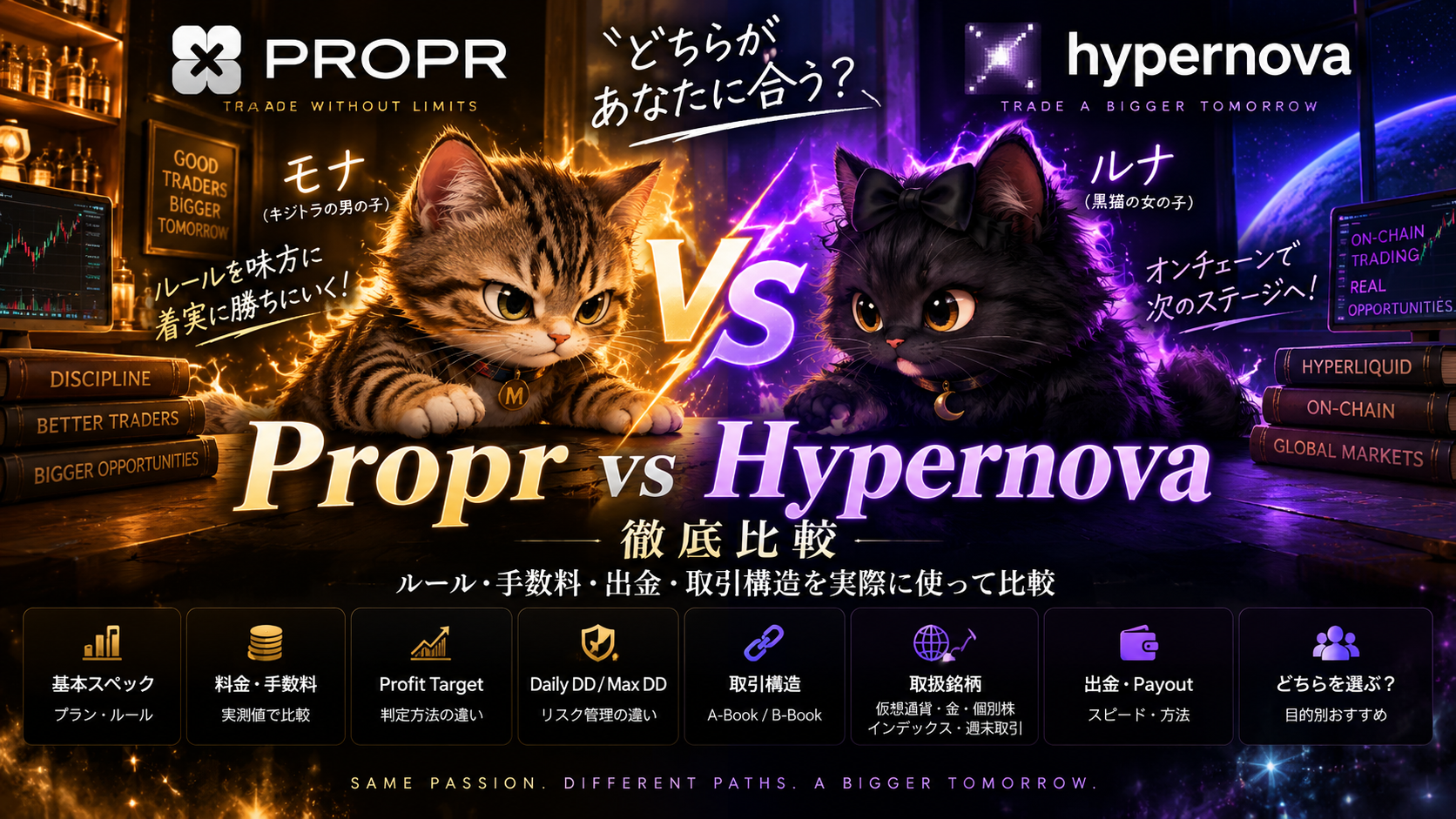


Dates and scope of this comparison
This English translation was prepared on November 6 and updated for publication on November 12, 2026 (JST). It preserves the Japanese article’s dated comparison, including the September 30 fee correction. Translation date is not a blanket re-verification date. Historical prices, UI observations and published payout claims below are not guaranteed current terms. Official descriptions, USK’s observations and personal opinions remain separate. Both services involve fees and counterparty risk; neither passing nor a payout is guaranteed. The original Japanese hero asks “Which suits you?” and introduces the comparison of rules, fees, payouts and trading structure. Japanese figures are explained in English below.
Hypernova v1.4 verification: November 12, 2026 JST
November 12, 2026 (JST): Checked official Rulebook v1.4 (changelog dated November 2, 2026) and Payouts. Corrected equity-based target triggers and automatic closing, funded activation, payout conditions, the 90% option, loss-limit warnings and account limits. The changelog aligns the documentation with behavior already enforced on the platform; it does not establish that these rules began on November 2. Historical screen evidence and experiences are retained.
The verified current 90% profit-share add-on costs 15% extra. Low $25K remains $280 in the current Rulebook. Current Trading Fees confirms the retained Hypernova fee table. Propr facts are not re-certified by this Hypernova update.
Revision history
November 12, 2026 (JST): Checked official Rulebook v1.4 (changelog dated November 2, 2026) and Payouts. Corrected equity-based target triggers and automatic closing, funded activation, payout conditions, the 90% option, loss-limit warnings and account limits. The changelog aligns the documentation with behavior already enforced on the platform; it does not establish that these rules began on November 2. Historical screen evidence and experiences are retained.
September 30, 2026: Rechecking Hypernova’s official fees showed stock/ETF Taker fees of 0.03%, not 0.005%. The latter rate belonged to commodities, indices and FX. The figure, examples and conclusions were corrected.
September 28, 2026: Propr’s Japanese UI description was updated with USK’s experience from challenge to funded status. Usability impressions and occasional freezes were added. The $25K prices and Hypernova figures were not changed in that revision.
September 11, 2026: Propr’s non-crypto Maker/Taker labels had been reversed. They were corrected to Maker 0.0030%, Taker 0.0090%, with related calculations and conclusions updated. The September 30 correction takes precedence for Hypernova stock fees.
1. Which should you choose?
If evaluation options and Propr’s rule structure matter most, Propr may be worth examining. If you want to compare Hypernova’s on-chain design, including the current Private Beta constraints, Hypernova deserves a closer look.
Sharing Hyperliquid infrastructure does not mean sharing the same fees, payout process or evaluation model. This article asks which priorities lead to which choice, rather than declaring an overall winner.
Toreko: You’ve written about both. Which one is better?
USK: Both use Hyperliquid, but the reasons for choosing them differ. Let’s separate what official sources said from what I saw on the trading screens, and work out who each might suit.
For more detail, see the Propr fees, rules and payout guide (Japanese) and Hypernova risk-tier, fee and payout guide. You can also browse Hyperliquid-related articles (Japanese).
2. The conclusion first
USK: My view was that Propr stood out for usability and evaluation choices, while Hypernova was interesting for its published payout design and on-chain records. Trading fees depended on the asset and whether the order was Maker or Taker. For stock Taker orders, the rates in this historical comparison favored Propr.
- Propr: No consistency rule in the reviewed terms, API/bot support and a 2-Step option.
- Hypernova: Published payout guidance described about five seconds from request to the embedded wallet; fees were listed by asset class, and evaluations were organized by risk tier. The five seconds was an official description, not USK’s measurement.
Private Beta conditions
The current official documents use Private Beta. Its $10,000 gross-profit payout cap applies per user per UTC day across Funded accounts. Check current invitation availability before registration.
Visit Propr through USK’s referral link.
The source advertised OWNTHEHOUSE for 30% off for first-time/new users using this route. Current availability, eligibility and expiry are not verified here. The calculations below show the historical offer, not a promised discount.
Visit Hypernova through USK’s invitation link.
Both are affiliate/referral links. Hypernova’s source-era invitation capacity was limited, so the link did not guarantee registration.
3. Basic specifications
How to read the comparison
The source comparison used official websites and rulebooks, except for Propr’s specific fee percentages, which USK read from order screens and related displays. Propr’s official claim was to apply Hyperliquid’s standard Maker/Taker fees without markup. All rows below are historical comparison conditions, with Hypernova rules updated to v1.4 on November 12 JST and Propr observations retaining their original scope. Market counts were not harmonized across differently dated pages: this comparison recorded 140+, while the Propr guide recorded an earlier 160+ claim.
Historical basic comparison
| Item | Propr | Hypernova |
|---|---|---|
| Company / service | Propr Limited, British Virgin Islands; developed by XBorg, backed by SwissBorg | Hypernova Systems, Cayman Islands; backing including Lemniscap |
| Evaluation choices | Classic 1-Step, Turbo 1-Step, Pro 1-Step, Classic 2-Step | Tight, Low, Medium; 1-Step. High is Edition-only |
| Account sizes | $5,000–$200,000 | $5,000–$200,000 |
| Concurrent evaluations | Multiple evaluations allowed | $300,000 combined Assessment/Funded starting capital; two-assessment cap removed |
| Profit targets | 9–12% for 1-Step; 2-Step 5% then 10% | 9–10%, depending on tier |
| Daily drawdown allowance | 1-Step 3%; 2-Step 5%; recalculated from start-of-day balance | Tight/Low 3%, Medium 4%, High 5%; 00:00 UTC balance reference |
| Maximum drawdown | 1-Step 3–6% static; 2-Step 8% trailing | Tight 3%, Low 6%, Medium 7%, High 8% static (High is Edition-only) |
| Drawdown model | Static for 1-Step; trailing only for 2-Step | Static across tiers |
| Profit-target measurement | Equity including unrealized P&L | Equity including unrealized P&L; touch triggers closing, order cancellation and pass |
| Daily-loss / maximum-DD enforcement | Equity including unrealized P&L | Equity including unrealized P&L; balance used to calculate the allowance |
| Trader share | 80% across sizes and types | Standard 80%; 90% at purchase for 15% extra assessment fee (Tight/Low/Medium) |
| Time limit | None stated | No evaluation deadline; the old three-month inactivity claim was not found in current official documents and is removed |
| Minimum trading days | None | None |
| Consistency rule | None | None |
| News trading | Unrestricted | Unrestricted |
| Weekend trading restriction | None stated | None stated |
| Scalping | Unrestricted | Unrestricted |
| EA / bots | Allowed; API and SDK provided | Automation on your own account allowed |
| Copy trading | Conflicting official documents: rulebook allowed copying across own accounts, terms Annex 2 prohibited it | External signal and copy-trading services prohibited |
| Market count | 140+ (source-era claim) | 106 perpetuals (official Markets, November 12 JST) |
| Maker fees | Crypto 0.0150%; stocks, indices, FX and commodities 0.0030% | Crypto 0.01%; stocks, ETFs, commodities, indices and FX 0% |
| Taker fees | Crypto 0.0450%; stocks, indices, FX and commodities 0.0090% | Crypto 0.04%; stocks/ETFs 0.03%; commodities, indices and FX 0.005% |
| Funding | Hourly, referencing Hyperliquid | Hourly, referencing Hyperliquid |
| Payout selection | 80% share; minimum $20; full-profit sweep only | Standard 80% or optional 90%; selectable gross amount; flat and other conditions apply |
| Payout method and published timing | USDC on-chain; official pages differed between minutes and within 24 hours | USDC on Arbitrum; official payout description said about five seconds from request to embedded wallet; Private Beta $10,000 gross profit per user per UTC day across Funded accounts |
| KYC | Not at evaluation purchase; required before funded activation and first payout; ID and selfie | Government photo ID and selfie; completed KYC plus wallet-signed Agreement before activation |
| Platform | Own web terminal at app.propr.xyz; Japanese UI; no MT4/MT5/cTrader listing found | Own web terminal at app.hypernova.xyz; automatically created embedded wallet; no MT4/MT5/cTrader listing found |
| Japanese support | UI checked by USK; legal terms/rulebook in English | Japanese UI not found in USK’s use; English interface |
| Weekend availability | Perpetuals including gold, stocks and indices could be held/traded | Same broad availability described; both could have thinner liquidity than weekdays |
| Gold | Available under commodities | Available under TradFi |
| Individual stocks | Available; check exact symbols in dashboard | Available; check exact symbols in dashboard |
| Indices | Commodity/index tabs | TradFi category |
Source article's official review and USK fee-screen observations
Propr’s advantage in evaluation choice refers specifically to the availability of 2-Step, not an overall quality ranking. For current Hypernova concurrency, use the combined-capital conditions in section 15; the old asset-class restriction is not current. The source rated weekend access and approximate market counts as broadly comparable, but exact symbols and tradability need checking.
4. Comparing evaluation fees
The source used a $25,000 account common to both services and compared regular prices before any discount. These are historical prices, not a live quote.
Historical regular prices: $25,000 account
| Category | Propr regular price | Hypernova |
|---|---|---|
| Lowest-cost option | Turbo 1-Step: $125; target 9%, DD 3% | Tight: $120; target 9%, DD 3% |
| Standard option | Classic 1-Step: $275; target 10%, DD 6% | Low: $280; target 10%, DD 6% |
| Other 1-Step option | Pro 1-Step: $185; target 12%, DD 5% | Medium: $365; target 10%, DD 7% |
| Two-stage evaluation | Classic 2-Step: $250; 5% then 10%, trailing DD 8% | None; 1-Step only |
Source comparison; Hypernova v1.4 document values; Propr historical comparison
The third row is not a like-for-like risk allowance: Pro and Medium have different targets and drawdown limits. The November 12 JST check of the current Rulebook confirms Hypernova Low $25K at $280. It does not verify a live checkout price.
USK's key point
Regular prices alone did not tell the whole source-era story. If a first-time user qualified for Propr’s 30%-off offer, the historical Propr prices fell below the corresponding Hypernova prices shown. That conclusion is conditional on eligibility and the quoted prices, not proof that the offer remains available today. There is no matching Hypernova 2-Step product to call cheaper or more expensive.
Historical calculation if Propr's 30% offer applied
| Category | Propr at 30% off | Historical Hypernova price |
|---|---|---|
| Lowest-cost class | Turbo: $125 × 0.70 = $87.50 | Tight: $120 |
| Standard class | Classic: $275 × 0.70 = $192.50 | Low: $280 |
| Other 1-Step | Pro: $185 × 0.70 = $129.50 | Medium: $365 |
| Two-stage | Classic 2-Step: $250 × 0.70 = $175 | No equivalent |
$25,000 accounts; discount not currently reconfirmed
Toreko: For the tightest-risk options, which was cheaper to start?
USK: If eligible for that first-purchase discount, Propr had the lower fee in the comparison. But it also offered 2-Step, so I’d compare how the evaluation works as well as the price.
5. Profit-target triggers and automatic closing
USK: Hypernova’s current official rule also uses equity including unrealized P&L. The old Propr-equity versus Hypernova-balance comparison has been corrected.
Equity = balance + unrealized profit/loss
Propr
EquityEquity-based target in the reviewed rules. USK’s historical pass observation applies to the tested account.
Hypernova · Rulebook v1.4
EquityA brief touch of the target triggers all three steps:
1. Close open positions
2. Cancel open orders
3. Pass the assessment
Daily DD is a separate calculation: balance determines the daily allowance; equity is monitored against the loss floor.
Official Hypernova Rulebook §08 · Checked November 12, 2026 JST
Hypernova Rulebook §08 says even a brief touch triggers automatic closing of positions, cancellation of open orders and an assessment pass. This is distinct from balance used to calculate the Daily DD allowance.
Toreko: So I cannot assume floating profit is ignored until I close the trade?
USK: Correct. Do not assume the position can keep running beyond the target. Propr’s historical observation and Hypernova’s current official description have separate evidence.
The incorrect historical Balance diagram is replaced by the web-native flow above; its source file and historical evidence remain intact. The November 2 v1.4 changelog corrects documentation to existing behavior, not necessarily a new start date.
6. Maker and Taker fees
“Limit” and “market” are shorthand only. The actual classification depends on supplying or taking liquidity; a limit order that executes immediately can be Taker.
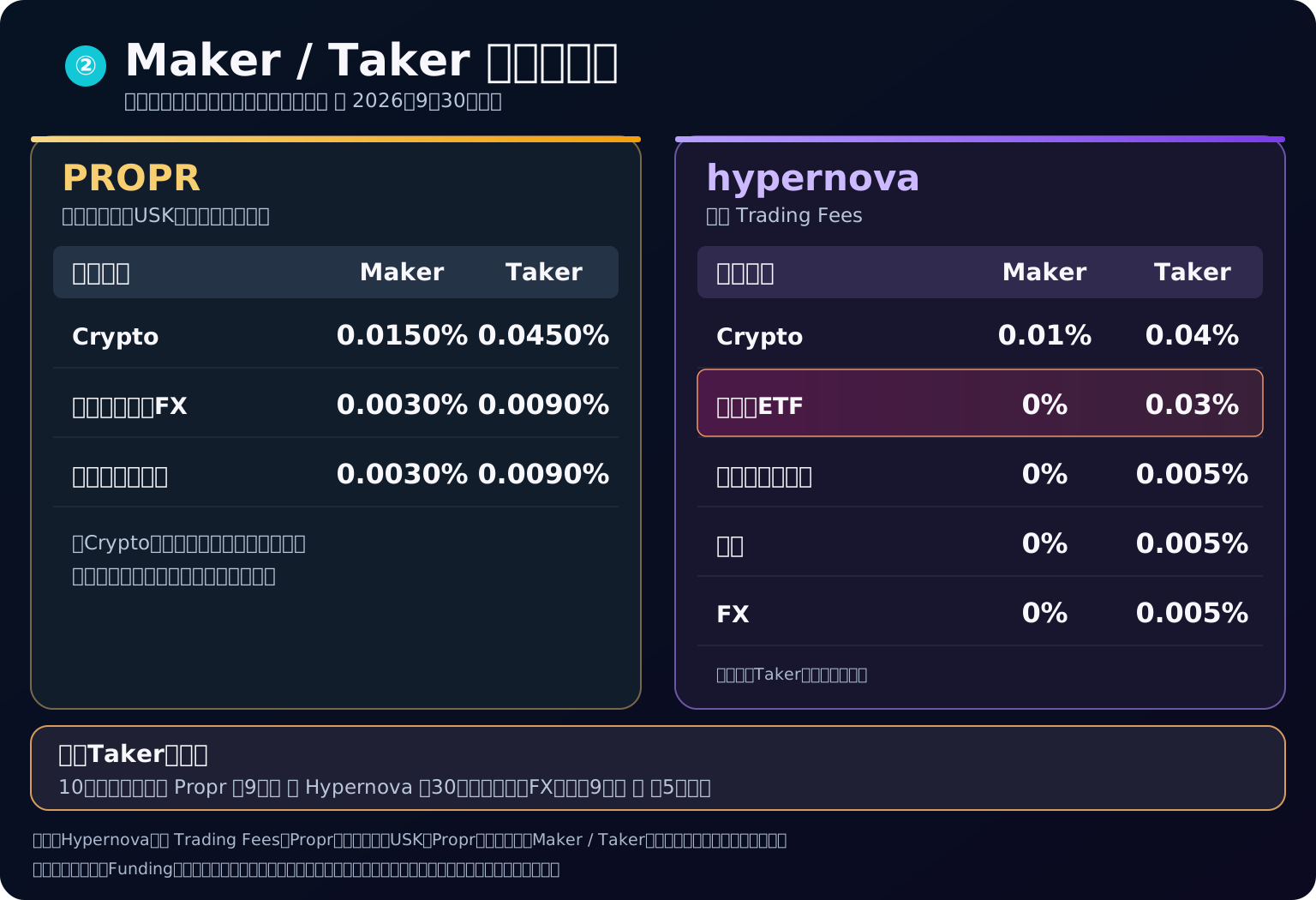 Japanese figure 2, corrected September 30: Hypernova stocks/ETFs show 0.03% Taker, while commodities, indices and FX show 0.005%. It replaces the older figure that incorrectly gave stocks 0.005%. These are historical comparison rates.
Propr’s official rules describe standard Hyperliquid fees without a Propr markup. Its percentages in this comparison came from USK’s screens. Hypernova’s figures came from the official Trading Fees page, rechecked for the source on September 30, 2026. The dedicated Trading Fees page was directly rechecked on November 12, 2026 (JST) and agrees with the Hypernova rates below. These are published rates, not a new execution test.
For English readers, the full figure’s numbers are:
| Asset | Propr Maker | Propr Taker | Hypernova Maker | Hypernova Taker |
|---|---|---|---|---|
| Crypto | 0.0150% | 0.0450% | 0.01% | 0.04% |
| Stocks / ETFs | 0.0030% | 0.0090% | 0% | 0.03% |
| Commodities, including gold | 0.0030% | 0.0090% | 0% | 0.005% |
| Indices | 0.0030% | 0.0090% | 0% | 0.005% |
| FX | 0.0030% | 0.0090% | 0% | 0.005% |
Propr’s source label grouped stocks, indices and FX as TradFi. The combined stocks/ETFs row reproduces the comparison category; it does not establish availability of every ETF at Propr. Check the instrument list.
These rates exclude funding, spreads, slippage and evaluation purchase costs. They are a trading-fee comparison, not a total-cost comparison.
At the listed rates, a one-way $100,000 Taker execution would cost:
- Stocks: Propr $9 versus Hypernova $30.
- Indices or FX: Propr $9 versus Hypernova $5.
It would therefore be incorrect to say all TradFi trades cost $5 at Hypernova. The calculation is not a round-trip estimate.
USK: At these historical rates, Hypernova’s Maker fee was lower across comparable categories. Its Taker fee was lower for crypto, commodities, indices and FX, but stocks reversed the result: Propr 0.0090%, Hypernova 0.03%. This is trading commission, not cost including spreads.
Toreko: So for stocks, Maker versus Taker changes the comparison?
USK: Exactly. Hypernova’s stock Maker was 0%, but Propr’s stock Taker was lower. I’d also consider the Japanese UI and evaluation rules, not only the commission.
USK's key point
In the corrected source rates, stock Taker was Propr 0.0090% versus Hypernova 0.03%, while Hypernova stock Maker was 0%. Compare the same asset class and liquidity role, and verify today’s applicable rate.
7. Daily and maximum drawdown
USK: The daily-loss concepts were similar, but maximum drawdown differed. Propr’s 2-Step used a trailing model; Hypernova’s reviewed risk tiers were all static.
The reviewed rules calculated Propr’s daily allowance from start-of-day balance and Hypernova’s from the previous closing balance. Hypernova used balance to calculate the dollar allowance, but equity including unrealized P&L to enforce it. Do not confuse a balance-based allowance with monitoring only closed trades or only at day-end.
Propr’s 2-Step alone used trailing maximum drawdown; Hypernova’s tiers used static maximum drawdown. The Propr guide describes an equity high-water mark, not a promise that only realized balance drives its trailing mechanism. Its November 6 recheck found inconsistent payout-adjustment descriptions, so that detail needs clarification.
USK's key point
Separate three questions: how the daily allowance is calculated, what is monitored for a breach, and what triggers a profit-target pass. They need not use the same balance/equity basis.
Rulebook §04 also describes a notification while a position is open when equity has used 90% of either the daily or maximum loss allowance. The notification channel is not specified. A warning is not a guaranteed buffer: equity touching the Daily or Max Loss floor causes a breach. Do not wait for a warning before managing risk.
8. Trading structure
USK: “Hyperliquid-based” did not mean identical order routing. Propr described sending some signals to Hyperliquid, while Hypernova described processing orders through its own engine.
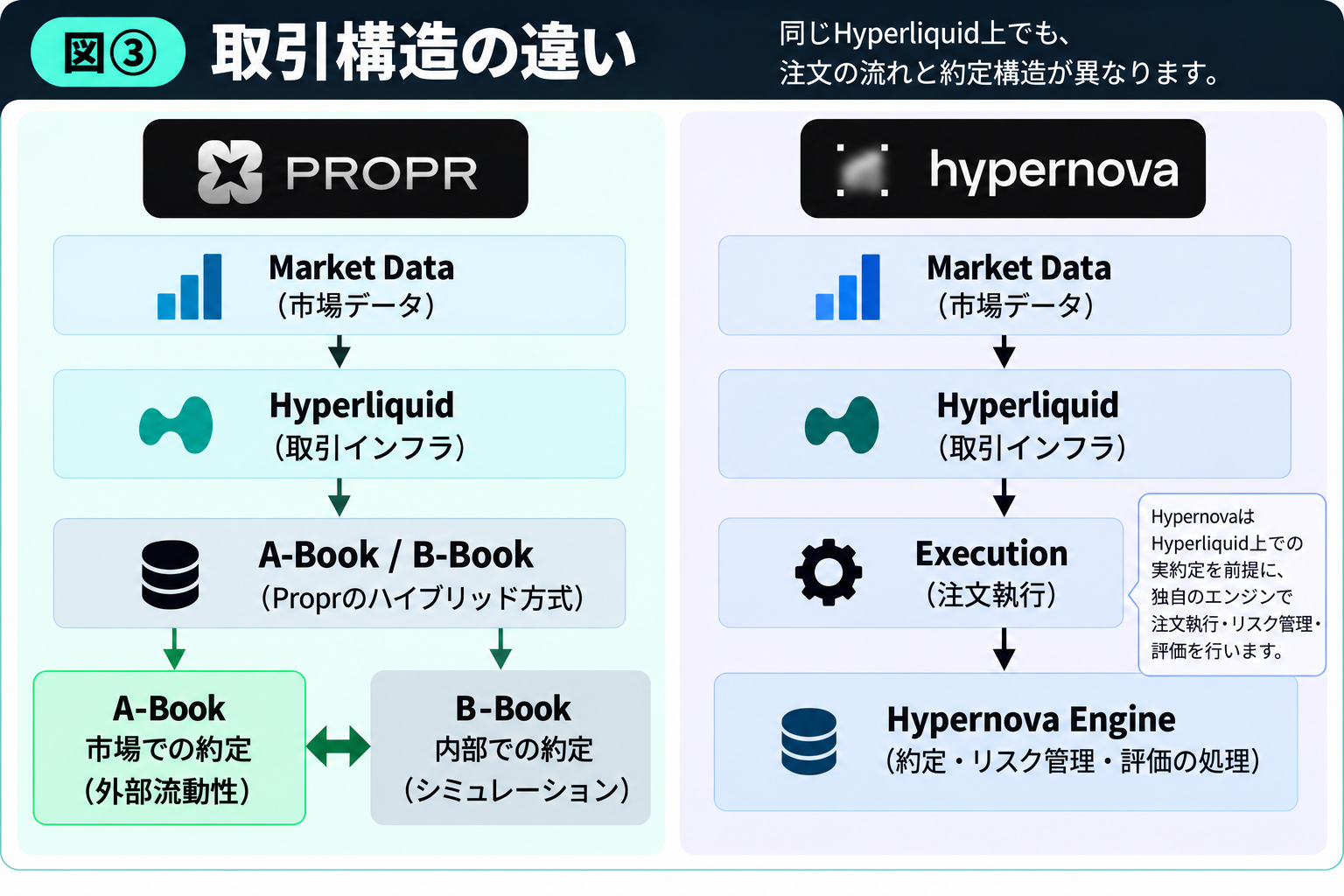 Japanese figure 3 contrasts Propr’s A-Book/B-Book hybrid with Hypernova’s engine. Its Hypernova side contains wording implying actual Hyperliquid fills; that wording should not override the source text’s explicit statement that Hypernova does not directly route these orders to Hyperliquid. The diagram is a simplified illustration, not proof of internal processing.
The source official descriptions said Propr obtained Hyperliquid market data and chose A-Book or B-Book per trade. Hypernova also obtained Hyperliquid market data, but executed in its own engine rather than routing orders directly there.
Toreko: So using Hyperliquid doesn’t mean every order goes to the same place.
USK: Right. We can compare what the documents describe without pretending we have audited every internal decision.
9. What Hyperliquid does for each
USK: Propr used Hyperliquid for market data and some execution. Hypernova used it for market data in the source description. Keeping those roles separate makes it easier to understand what can actually be checked on-chain.
Infrastructure is not a counterparty guarantee. Neither the Hyperliquid name nor an on-chain record guarantees either firm’s solvency, legal performance, eligibility decisions or future payouts.
10. Funding
USK: The source rules described hourly funding for both, at the UTC hour, referencing Hyperliquid funding rates. This was not a major difference between them in the comparison.
11. Available markets
The earlier comparison recorded Propr 140+ and Hypernova 140. Current Hypernova Markets lists 106 perpetuals as checked November 12 JST. Propr retains its dated scope. Check whether the specific instrument you want is actually available in your account.
USK: Hypernova currently lists 106 perpetuals. The companies’ figures here have different verification dates, so checking your desired instruments is more useful than treating them as a same-day inventory comparison.
Toreko: Both included gold, individual stocks and indices. Could both be traded on weekends?
USK's key point
The source described weekend access for both as a notable feature. These are perpetual contracts referencing assets, not cash ownership of stocks or physical gold. Weekend liquidity can be thinner, so spreads and execution should not be assumed to match weekdays.
12. Comparing payouts
USK: The source-era published profit shares were around 80%, but the request method, advertised processing time and limits differed. The current Hypernova purchase-time 90% option is separately described below.
What USK had actually tested
The payout conditions, advertised times and caps here came from official sources. At the time of this comparison I had not personally tested request-to-receipt payouts with either Propr or Hypernova. Actual processing time and usability remained unverified by me.
- Propr: $20 minimum, full-profit sweep. Official pages differed between “minutes” and “within 24 hours”. The source did not establish which stages those descriptions measured: request, approval, on-chain transmission or receipt.
- Hypernova: No minimum and selectable amounts. Its official payout page described approximately five seconds from requesting a payout to USDC arriving in the embedded wallet. The current Private Beta cap is $10,000 gross profit per user per UTC day across all Funded accounts; eligibility and review conditions below also apply.
These descriptions are not equivalent end-to-end measurements by the same observer. “Five seconds” is not a guarantee that every eligible request will settle at that speed.
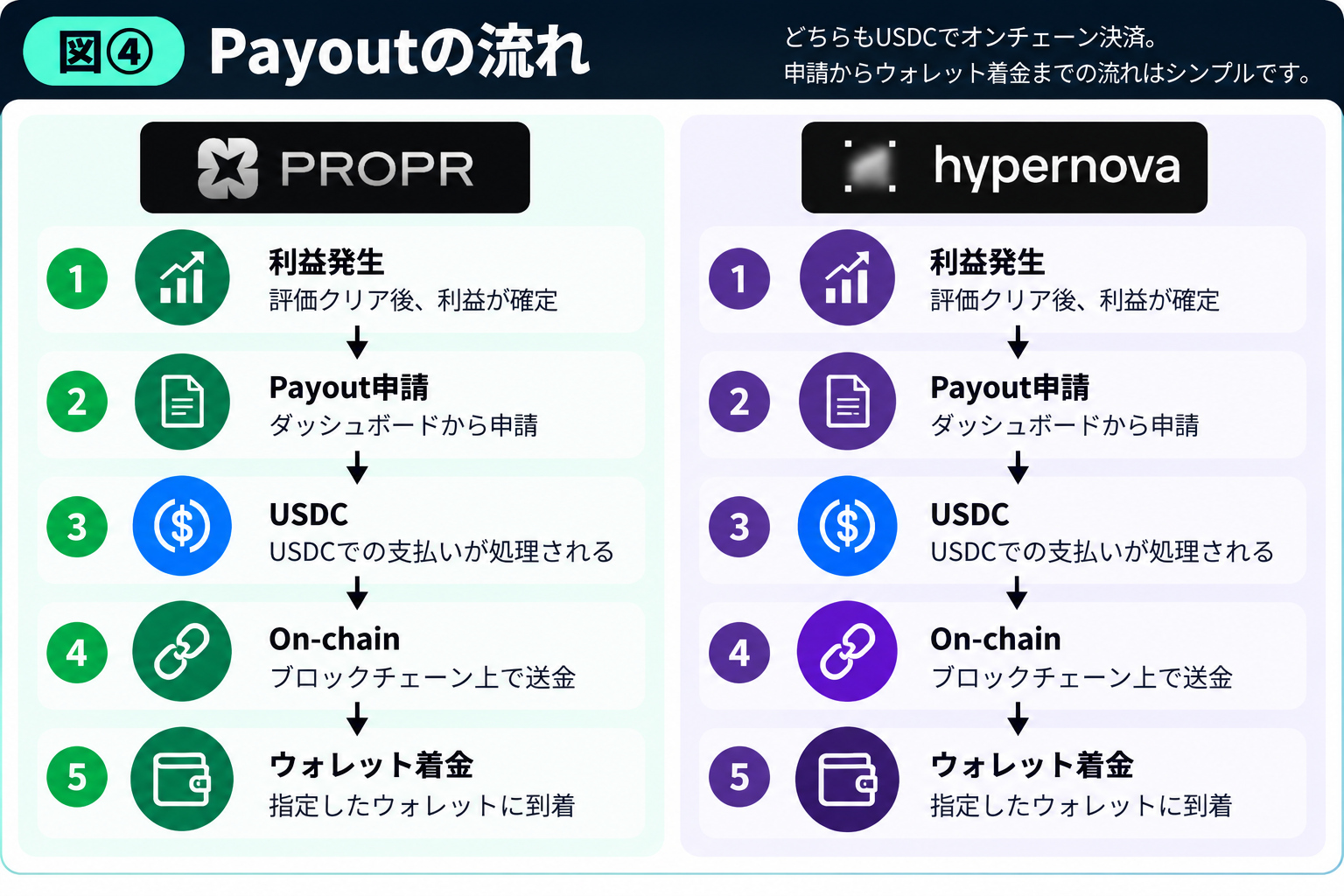 Japanese figure 4 shows both firms’ simplified flow: eligible profit after evaluation, a dashboard request, USDC processing, on-chain transfer and wallet receipt. The source describes Hypernova smart-contract settlement, but this generic diagram is not a transaction receipt, timing test or proof of automatic approval.
Review Propr’s official terms through USK’s referral link. The source’s new-user OWNTHEHOUSE 30% discount is historical and needs checkout confirmation.
Review Hypernova through USK’s invitation link. Historical invitation limits mean registration is not guaranteed by the link.
Current payout conditions (checked November 12, 2026 JST)
The official Rulebook §10 and Payouts specify:
- No minimum payout amount, but an active Funded account in profit and approved KYC are required. The account must be flat: no open positions, pending orders, active TWAPs or pending pair trades.
- A short payout waiting period after the first assessment purchase. The public documents do not specify a fixed number of days or hours; check the dashboard’s eligibility state rather than assuming one.
- At least one new round-trip trade (open and close) between payouts.
- During Private Beta, a $10,000 gross-profit cap per user per UTC day, combined across all Funded accounts. This is the amount before the trader’s profit split, not take-home cash.
- An 80% standard trader share. Tight, Low and Medium offer a 90% option at purchase for a 15% increase in the assessment fee. This does not automatically upgrade existing accounts. A $1,000 gross request at 80% pays $800 to the wallet.
- Identity, compliance, fraud or risk review may hold an account or payout. The published approximately five-second process is not a guarantee for every request.
A payout is not treated as a loss for Daily DD. Rulebook §05 lowers that day’s daily equity limit by the payout amount. The next day’s limit is recalculated from balance at 00:00 UTC. This is separate from the static maximum-loss floor.
13. What is recorded on-chain?
The source official descriptions said Propr’s A-Book execution and hedging wallets could be checked on Hyperliquid. Hypernova described account records, rules, agreement signatures and payouts associated with TradingAccounts, Vault and Reserve-wallet infrastructure on Arbitrum, viewable through Arbiscan.
USK: Propr described verification of trades actually executed in the market. Hypernova described a wider set of records from account administration through payouts. My impression was that Hypernova explained the scope of those records more specifically.
That is an assessment of the published descriptions, not an independent contract audit or proof that every operational decision is decentralized. Visible records do not eliminate either firm’s counterparty risk.
14. Evaluation formats
USK: Propr offered both 1-Step and 2-Step. Hypernova offered 1-Step only. If you want a staged evaluation, Propr has that option; if you prefer one stage, either has a one-stage route, with Hypernova organizing it by risk tier.
15. How many accounts can run at once?
The source describes Propr allowing multiple evaluations from v1.0.1 onward.
Under Rulebook §15, self-service Assessment and Funded accounts share a $300,000 combined starting-capital cap, including suspended Assessments and passed Funded accounts not yet activated. Demos are separate. The v1.4 correction removes the two-ongoing-assessment limit; the old one-per-asset-class explanation is not the current rule.
New Assessments include all markets. Existing Crypto/TradFi accounts retain their previous market access. Do not infer the applicable version for every old account; check its purchase/activation terms and account display.
16. Automated and copy trading
USK: Propr’s API and SDK made its automation offering relatively explicit. Hypernova also allowed automation on your own account, but restricted external signals and copy trading.
The source official information described Propr API/SDK support and Hypernova permission for own-account automation, while prohibiting external signal services and copy-trading services. Automation permission does not cancel other prohibitions.
17. Prohibited conduct
Both source rule reviews prohibited account sharing, impersonation, latency arbitrage and wash trading.
Propr’s documents conflicted: its rulebook permitted copying between one’s own accounts, while Annex 2 of the evaluation terms prohibited it. It prohibited hedging both between Propr accounts and against external accounts. Hypernova prohibited external copy trading and changing strategies between the assessment and funded account.
USK: The basic prohibitions overlap, but copying is not handled identically. Propr’s documents were inconsistent and hedging was prohibited. I’d clarify the applicable rule before using a strategy that depends on it.
See the Propr guide (Japanese) and Hypernova guide for the fuller source discussion of automation, prohibited conduct, KYC and interface support.
18. KYC and Funded activation
The source describes Propr requiring government ID and a selfie before funded activation and the first payout. Those Propr conditions are not independently refreshed by this Hypernova update.
Passing the assessment does not by itself activate a Funded account. Rulebook §09 requires completed KYC and a wallet signature on the Funded Trader Agreement.
The official identity-verification FAQ says registration, deposit and assessment do not require KYC, but Funded activation does. The flow is Settings → Payouts, using government-issued photo ID and a camera selfie; the trader must be at least 18. These are official instructions, not a claim that USK completed this process in the current review.
19. Japanese-language support
The source review found both firms’ legal terms and rulebooks in English.
USK: I used Propr’s Japanese UI from the challenge through funded status, which helped a lot. Hypernova was not in Japanese during my use. On that point, Propr felt easier for me to get started with.
20. My hands-on impressions
Toreko: After trying both, how did usability compare?
USK: Personally, I found Propr’s layout easier to follow, especially in Japanese. I did experience occasional freezes during the challenge, which is a drawback. My impression was that I saw them more on weekends, not that the whole challenge was constantly unstable. They bothered me, but did not feel fatal to the experience.
Toreko: What did you like about Hypernova?
USK: The fees I saw before placing HYPE and GOLD orders were appealing. But the corrected official stock Taker rate was higher at Hypernova. I hadn’t tried a payout at either firm, so that was still something to test later.
I used Propr first and became familiar with it before trying Hypernova. That order may have affected my impression of usability.
Read my actual Propr challenge-pass report (Japanese).
21. Who Propr might suit
USK: In my view, Propr was worth considering for Japanese UI support, evaluation options and an explicit automation offering. A qualifying introductory discount could also reduce the starting fee, but only if actually available to you.
- You want a Japanese trading interface.
- You prefer no consistency rule and the possibility of reaching the target in one trade.
- You want a 2-Step option as well as 1-Step.
- API/bot trading is important to you.
- You qualify for a valid first-purchase offer, rather than assuming the historical 30% coupon still applies.
22. Who Hypernova might suit
USK: At the source-era rates, Hypernova was interesting for Maker-heavy trading and non-stock Taker fees, along with its published payout design and on-chain records. It might suit someone comfortable with English and a one-stage evaluation, provided the current terms fit.
- You primarily supply liquidity as Maker, or trade crypto, commodities, indices or FX as Taker, and have checked current rates.
- You place weight on the published payout process, without treating an advertised time as a measured guarantee.
- You value the stated scope of on-chain records.
- You want to select a risk tier for a 1-Step evaluation.
- You are comfortable using an English interface.
23. Conclusion
Toreko: If I’m still undecided, what should I compare first?
USK: Propr appealed to me for Japanese usability and evaluation options. Hypernova was a candidate for Maker-heavy trading, while the historical stock Taker comparison favored Propr. We can compare official payout conditions, but I hadn’t tested request-to-receipt usability with either. I’d consider the rules and interface alongside current fees.
USK's key point
Propr stood out for Japanese UI and evaluation choices. Fees must be compared by asset and Maker/Taker role, using current rates. The source’s stock Taker result favored Propr. USK had not tested an actual payout with either firm in this comparison.
Referral disclosure
The links below are USK’s affiliate/referral links. The source offered Propr’s new-user OWNTHEHOUSE 30% coupon and warned of Hypernova daily invitation limits. Neither the coupon nor available invitation capacity is newly verified here; confirm before making a purchase or registration decision.
Glossary
- Balance: Account balance reflecting realized P&L.
- Equity: Balance plus unrealized P&L on open positions.
- Daily drawdown: The allowed loss within a day under the applicable calculation and monitoring rules.
- Maximum drawdown: The overall account loss allowance under the specified model.
- Static drawdown: A floor fixed relative to initial balance.
- Trailing drawdown: A floor following an account high-water mark, subject to plan rules.
- Profit target: The profit threshold for evaluation completion.
- A-Book / B-Book: Market routing of a signal versus internal handling by the firm.
- Maker / Taker: Supplying liquidity with a resting order versus taking existing liquidity. A limit order can be Taker when it executes immediately.
- On-chain: A transaction or settlement record on a blockchain that can be verified; not a solvency guarantee.
- Hyperliquid: On-chain trading infrastructure used differently by the two services.
- KYC: Know Your Customer, identity verification.
- Payout: Receiving eligible funded-account profit under the firm’s terms.
Propr and Hypernova series
You are reading the comparison. For the fuller individual source reviews:
- Propr guide (Japanese): Fees, rules and official payout conditions, with screen evidence.
- Hypernova guide: Fees, risk tiers and official payout conditions, with screen evidence.
FAQ
Which would you recommend?
Propr was my preference for Japanese usability and evaluation options. Hypernova was a candidate for Maker-heavy trading and its published payout/on-chain design. Historical stock Taker fees favored Propr. These are conditional judgments, not a current lowest-cost ranking. Neither firm’s actual payout usability was tested by USK here. See chapters 21–22 and confirm the latest rules and fees.
How did profit-target measurement differ?
Hypernova v1.4 uses equity including unrealized P&L. A touch triggers position closing, order cancellation and passing. The old balance-based comparison is corrected. Balance used to calculate Daily DD is separate.
Which had lower trading fees?
At the corrected source rates, Hypernova had lower Maker fees across comparable categories and lower Taker fees for crypto, commodities, indices and FX. Stock Taker reversed the comparison: Propr 0.0090%, Hypernova 0.03%. This excludes spreads, slippage, funding and evaluation costs, and is not a new verification of current rates.
How did published payout conditions differ?
Propr’s source terms show 80%, a $20 minimum and full-profit sweep, with inconsistent timing descriptions. Hypernova has standard 80% or the purchase-time 90% option for 15% extra. It requires flat status, KYC, an initial waiting condition and a new round-trip between payouts. Private Beta caps gross profit at $10,000 per user per UTC day across Funded accounts. Review holds can apply; approximately five seconds is official guidance, not USK’s measurement or a guarantee. Payouts do not count as Daily DD losses.
Which evaluation was cheaper?
Some historical regular prices were slightly lower at Hypernova. If eligible for Propr’s historical 30% first-purchase offer, Propr’s listed $25K 1-Step fees were lower than the compared alternatives. There was no Hypernova 2-Step equivalent. Current prices and coupon eligibility require checking; the current Rulebook lists Hypernova Low $25K at $280, but this is not a fresh checkout verification. See chapter 4 for the dated calculations.
Who might each service suit?